Huber Heights planning commission denies Kwik Trip basic development plan at Old Troy Pike
Loading...
Summary
The planning commission voted 5–0 on Jan. 8, 2026, to deny Kwik Trip’s Basic Development Plan (BDP 2602) for a 6,440–6,455 sq ft convenience store and fuel sales at 8154 Old Troy Pike, citing traffic impacts, setback nonconformance and parking shortfalls. The applicant offered to eliminate one curb cut and to revise parking stall dimensions but commissioners found the site inappropriate.
Huber Heights — The planning commission on Jan. 8 denied a proposal by Kwik Trip to build a roughly 6,450-square-foot convenience store with fuel sales at 8154 Old Troy Pike, voting 5–0 to reject the Basic Development Plan (Case BDP 2602).
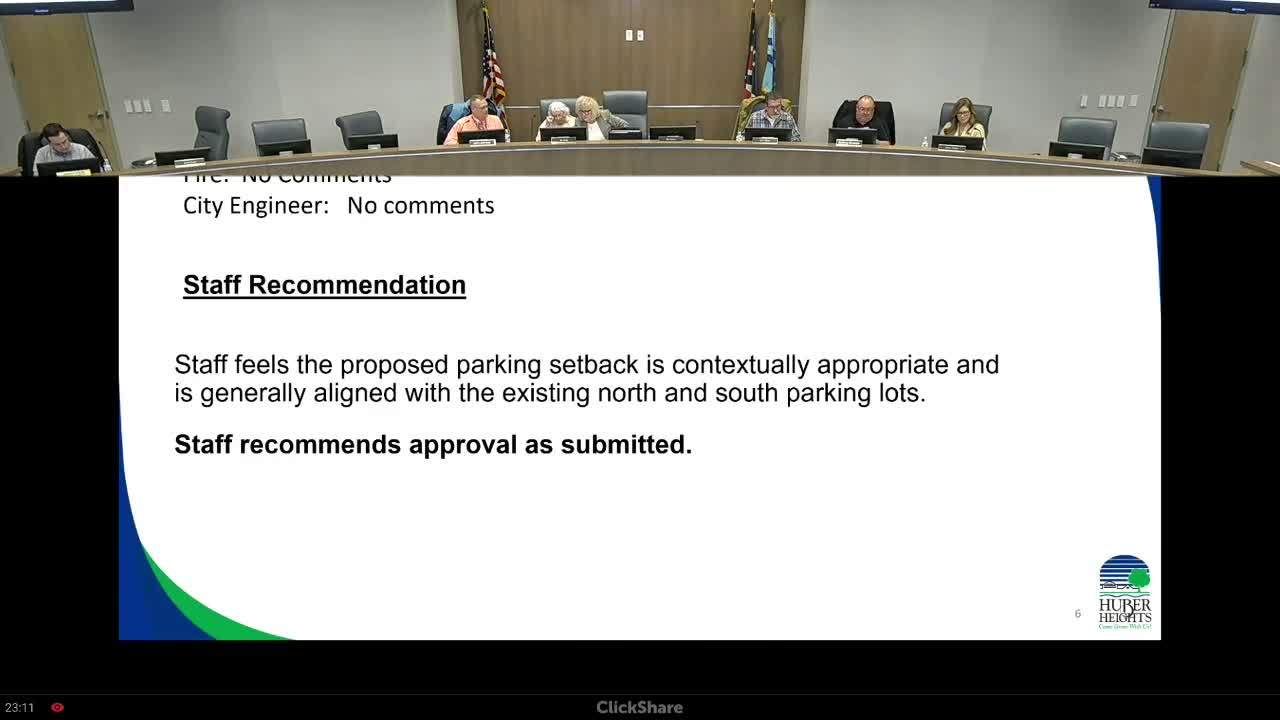
Staff warned the commission that the plan, as submitted, failed to meet several development standards and could worsen congestion at the intersection of Executive Boulevard and Old Troy Pike. "We're concerned that vehicles exiting that west curb cut won't have enough time to get into the left-turn lane," staff planner Aaron Sorrell said, citing peak-morning and -evening traffic patterns and the site's tight circulation.
Kwik Trip representatives said the company had submitted the application before the city's recently adopted moratorium on similar developments took effect and offered several concessions during the hearing. "We are making a multimillion-dollar investment in the community," said Gwen Keane, Kwik Trip real estate project manager. She added the company typically brings "on average 20 to 30 new jobs" to a location and that the applicant was willing to eliminate the west curb cut and to revise parking-stall widths to comply with code.
Residents who spoke at the public hearing pushed back on the location and the larger pattern of convenience-store growth along the corridor. "We're just turning into, like, a place filled with gas stations," resident Jade Taylor said, arguing the city should prioritize other kinds of development. Real estate professional Lisa Pratt warned of economic side effects, saying adding another large station in an already crowded market "isn't growth — it's cannibalization."
Commissioners repeatedly returned to technical shortcomings in the submission. Staff had counted 48 on‑lot parking spaces sized at 9½ by 18 feet while the zoning calculation based on building square footage required 52 spaces; staff also noted portions of the canopy and building did not meet required setbacks. The applicant argued that pump stalls could be counted toward the total and that closing the west curb cut would mitigate the chief engineering concern. Commissioners said those concessions were insufficient for this site.
"I don't believe Executive is adequate to handle the traffic flow that this usage would have," one commissioner said during the roll call explanation. The motion to approve was made by Mister Schomper and seconded by Miss Thomas; the roll call returned five 'no' votes and the application was denied.
Because the planning commission acts as a recommending body for basic development plans, the denial effectively halts the current submission. The applicant may revise and resubmit or pursue further administrative or legislative steps; staff noted the original application predated the moratorium and was processed on that basis.
The record shows the commission’s denial cited access, parking and setback nonconformance as the controlling issues; no formal variances or code waivers were granted at the hearing. The commission's transcript indicates staff and commissioners asked for additional police input and engineering follow-up that were not part of the packet.