Get Full Government Meeting Transcripts, Videos, & Alerts Forever!
Get email alerts on the Land Use Code topic
No spam. Unsubscribe anytime.
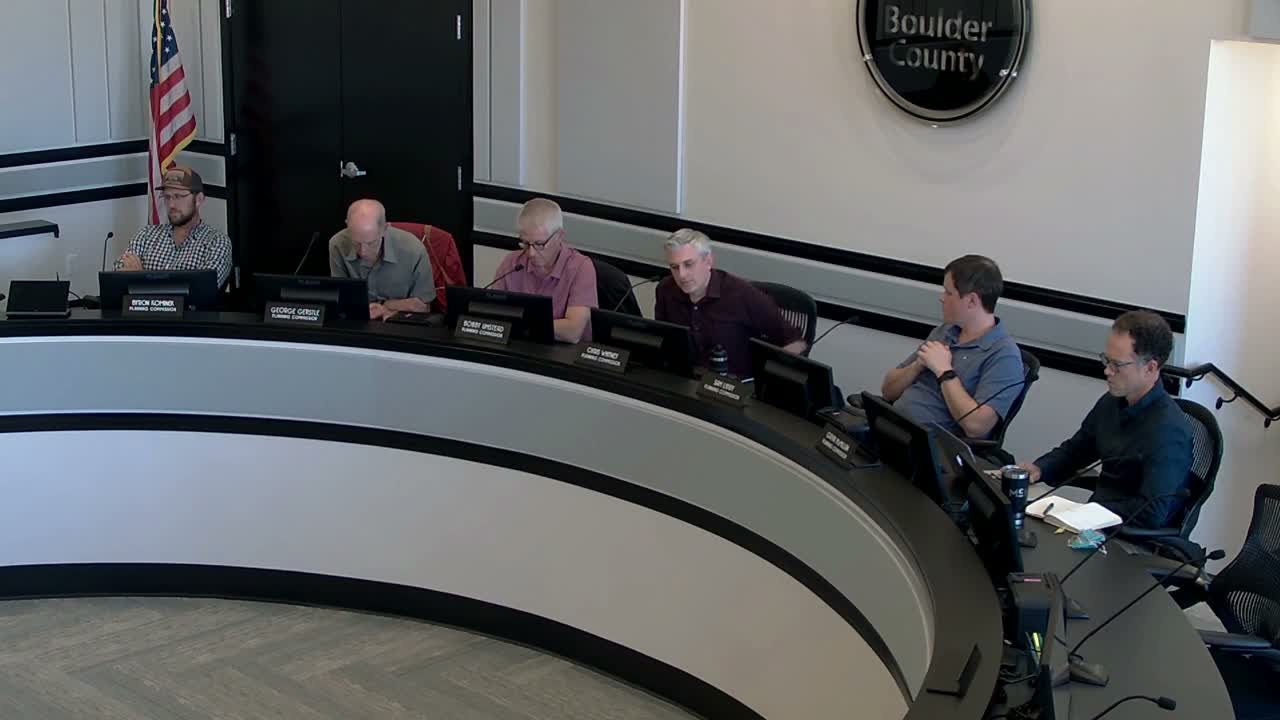
Boulder County planning commission backs code change to treat licensed group homes as households, asks staff to find path for larger facilities
Summary
The Boulder County Planning Commission voted Oct. 15 to recommend that the Board of County Commissioners approve text amendments (Docket DC240004) that add licensed group homes to the household definition and strike separate boarding‑house and group‑care/foster‑home uses, while directing staff to develop options for two existing larger facilities that would become nonconforming.
On Oct. 15, the Boulder County Planning Commission voted unanimously to recommend the Board of County Commissioners approve Docket DC240004, a set of land‑use code text amendments that would explicitly include state‑defined, licensed group homes in the county’s household definition and remove separate boarding‑house and group‑care/foster‑home uses from the code.
The change is intended to align the county’s zoning rules with federal fair‑housing law and recent state guidance treating licensed group homes as residential uses. Kaylee Byrne, long‑range planner with Community Planning and Permitting, told commissioners the proposed household language would make clear that “group homes that are defined, licensed, and or certified by the state … are households” and would be allowed wherever a dwelling unit is allowed, subject to the same occupancy limits as other households.
Why it matters: The amendment would simplify how the code treats small, residential‑scale group homes but also has practical consequences for larger or campus‑style facilities. Byrne identified four currently approved group‑care/foster‑home sites in the unincorporated county — Rose House, Ross Group Care Home, Mountain State Children’s Home and Sandstone Care Residential at the Alps — and said staff’s review indicates Rose House and Ross would likely fit the household/dwelling‑unit rules while Mountain State and Sandstone would become nonconforming uses.
Mountain State’s representatives warned of consequences. Nick Mears of Mountain State Children’s Home in Longmont said the organization’s concern “is how this change will now make Mountain State’s Children’s Home labeled as [a] nonconforming use,” which he said could prevent a growing nonprofit that has served the community for decades from expanding or altering facilities in the future.
Staff response and options: Planning staff and the deputy director, Kim Sanchez, acknowledged the tension and explained that nonconforming status generally limits properties to normal, routine maintenance and prevents expansion beyond previously approved terms. Sanchez said staff had discussed possible code approaches — including a narrowly tailored exception for board‑approved uses or a planned grandfathering approach — but highlighted a legal and policy tension in writing exceptions for uses the code would otherwise treat as beyond intended residential scale. She recommended staff return to the Board with options for how to address the two sites that would become nonconforming.
Occupancy and technical limits: Byrne detailed the county’s residential‑occupancy methodology: minimum bedroom area rules (roughly 70 sq ft for one occupant, plus ~50 sq ft for an additional occupant), sizing of on‑site wastewater treatment systems (OWTS) where applicable, and an upper structural threshold of 16 residents (a building‑code threshold distinguishing residential and commercial treatment). Staff said Sandstone houses about 24 residents and is a converted lodging use (formerly an inn), while Mountain State is configured as multiple dwelling units across a campus and supports up to about 40 children; those configurations are the reason they would be treated as nonconforming under the proposed text.
Commission action: After extended questioning and public comment, the Planning Commission moved to recommend the Board approve the docket with two pieces of feedback: (1) direct staff to explore code options to preserve a pathway for larger group‑care uses through special‑use review for existing and future sites that exceed residential‑scale thresholds, and (2) change the household definition language from the ambiguous phrase “single dwelling unit” to the clearer “1 dwelling unit.” Commissioner Ready moved the motion; it was seconded and passed unanimously.
Next steps: The Planning Commission certified the docket for action and forwarded the record, including staff materials and public testimony, to the Board of County Commissioners for final consideration. Staff said they will return with options and possible language for how to treat the two existing sites that would otherwise become nonconforming.