Get Full Government Meeting Transcripts, Videos, & Alerts Forever!
Get email alerts on the Land Use Code Cleanup topic
No spam. Unsubscribe anytime.
Planning Commission unanimously recommends approval of county land‑use code 'cleanup' amendments
Summary
Boulder County staff proposed scattered text amendments to fix formatting, clarify definitions and align the land‑use code with state law; the Planning Commission voted unanimously Dec. 17, 2025 to recommend approval and asked staff to explore administratively allowing clerical corrections to Article 16.
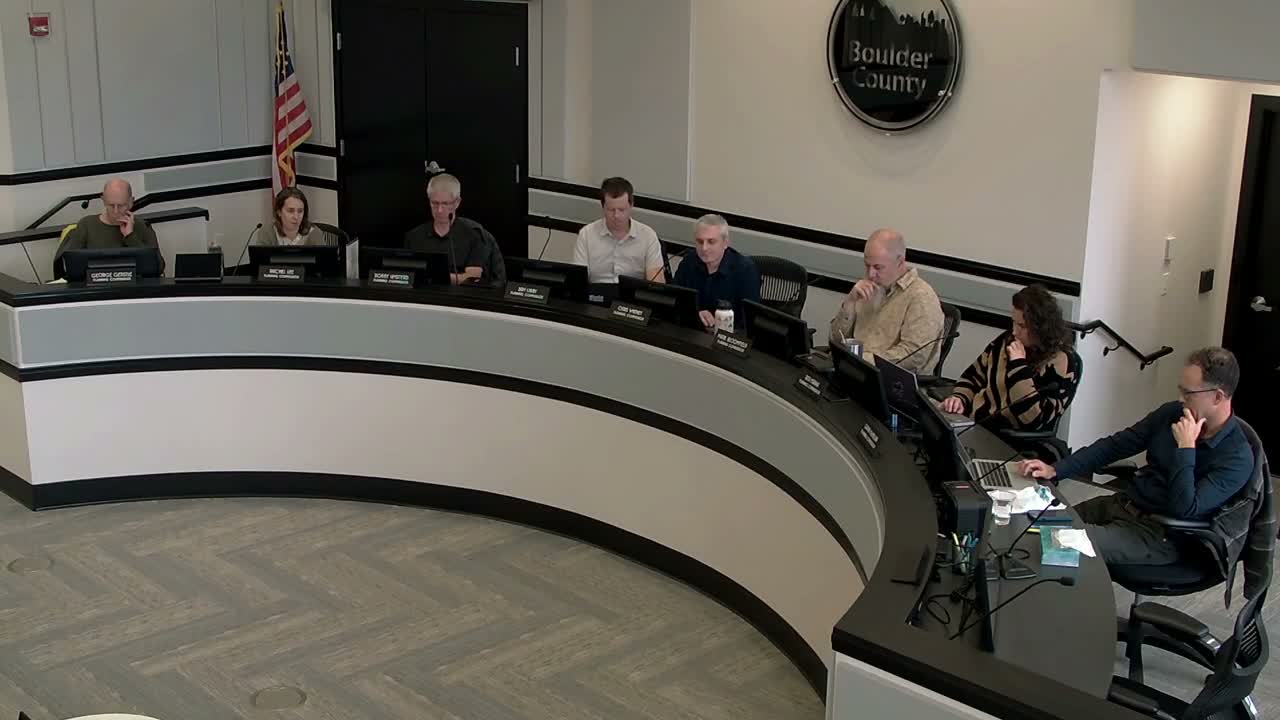
The Boulder County Planning Commission on Dec. 17 recommended that the Board of County Commissioners approve DC‑25‑0003, a package of text amendments to the county land‑use code aimed at correcting clerical and formatting errors, clarifying definitions and bringing code language into compliance with state law.
Staff presenter Ethan Abner, a long‑range planner with Boulder County Community Planning and Permitting, told the commission the docket is intended to improve readability and consistency across many code sections rather than introduce substantive policy changes. "We're proposing a variety of changes," Abner said, including aligning lists used in different articles, allowing pre‑application conferences to be held virtually or on‑site, and updating cross‑references and capitalization of defined terms.
The changes cited by staff include: harmonizing language in provisions governing the Board of Adjustment; clarifying that a site plan is required only for complicated pre‑application conferences on staff request; updating application submittal requirements to require statements of authority for nonlegal entities (for example, trusts or LLCs); adding a 30‑day appeals timeline for zoning district size limitation appeals; and revising multiple definitions in Article 18 (for example, stating that a railing up to 42 inches does not constitute an enclosure for the purposes of residential floor area). Staff also proposed reducing the required distance between manufactured homes from 14 feet to 10 feet to match current building‑code requirements and adding clearer language to address parking minimums in state‑identified transit service areas.
Abner said the changes respond to prior policy interpretations, referrals and a small number of external comments, noting two "no conflict" responses from referral agencies (the building division and Jefferson County) and a comment from a ditch company raising concerns about ditch setbacks. On the ditch‑setback issue, staff said addressing the full range of ditch‑specific setbacks was likely outside the scope of a code cleanup and recommended updating public handouts and internal maps first.
Commissioners asked clarifying questions on topics including whether previously adopted presumptive size and site‑plan rule changes were incorporated into the code, the rationale for the proposed manufactured‑home spacing change and how the county plans to comply with the state's EV charging model code. Abner said the land‑use code already reflects recent decisions and that the county reviewed the state model EV charging code and recommended a compliance pathway that does not require further land‑use amendments.
Commissioner Sam Libby moved that the Planning Commission recommend approval of DC‑25‑0003 and that staff consider amendments to Article 16 to allow easier administrative clerical corrections going forward; Commissioner Rachel Lee seconded. The motion passed by roll call, with commissioners voting "Aye" and one member marked not attending.
The Planning Commission recommendation will be transmitted to the Board of County Commissioners for final action. The commission’s motion also asked staff to return with a proposal addressing whether very minor clerical corrections should be eligible for an administrative process rather than a formal text amendment.
Actions: The Planning Commission recommended that the Board of County Commissioners approve DC‑25‑0003 (text amendments to the land‑use code) and requested staff consider an amendment to Article 16 to permit administrative clerical corrections.
The Planning Commission closed the public hearing on DC‑25‑0003 and moved on to a working session on the Boulder Valley Comprehensive Plan update.