Get Full Government Meeting Transcripts, Videos, & Alerts Forever!
Get email alerts on the Environmental Management topic
No spam. Unsubscribe anytime.
Boulder County updates Integrated Weed Management Plan pilots; public raises strong concerns about indaziflam and drone spraying
Summary
Parks and Open Space reported one-year progress on the 2024 Integrated Weed Management Plan, including pilot projects (weed warriors, goat browsing, steam weeding, soil amendments) and adoption of OpenGov tracking; several public commenters criticized past indaziflam testing and urged halting aerial/drone applications, while others urged balance and community restoration projects.
Joe Swanson, Boulder County's noxious-weed supervisor, presented a one-year update on the Integrated Weed Management Plan (IWMP) adopted by the county in 2024. Swanson highlighted seven plan goals and four management areas, said the county added a full-time field technician (Alex Windorf) and reported deployment of OpenGov asset-management software to track field work, herbicide applications, labor hours and to provide a public-facing workflow and notification page.
Swanson reviewed five pilot projects launched or continued in the first year: volunteer "weed warriors" and hand-pulling efforts targeting hairy willowherb at Pella Ponds; goat browsing/bio-browsing used across roughly 100 acres for weed suppression and fire-mitigation work; steam weeding in parking lots; a soil-amendment research pilot at Rabbit Mountain to evaluate native-vegetation establishment; and a planned drone-based indaziflam (Rejuvra/Esplanade) application on Red Hill to control cheatgrass, which contracting had approved for December pending weather.
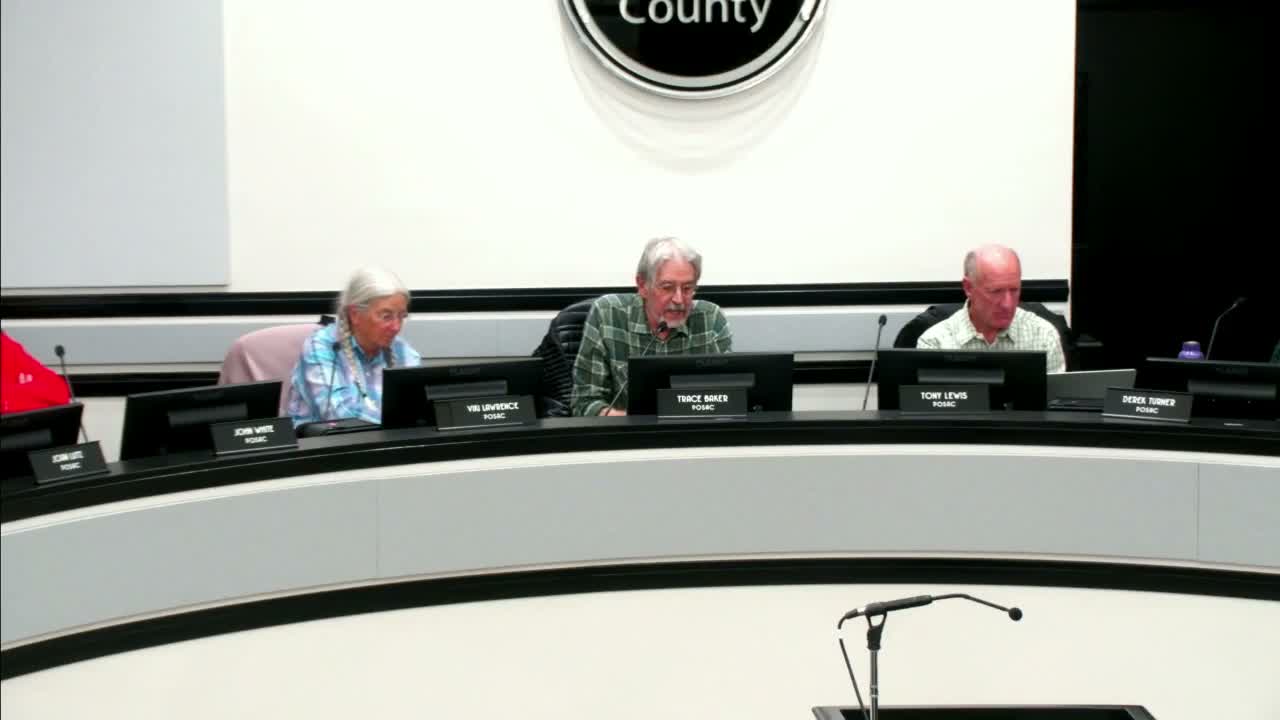
POSEAC members asked for the detailed annual report due in January, including metrics for acres treated, chemical quantities and concentrations, and urged public-facing transparency. Staff said the new database will improve reporting and that a heavily detailed annual report would be provided in January.
Several public commenters spoke at length and raised strong objections to past and planned use of indaziflam and aerial/drone applications. They alleged county testing expanded beyond initial plot trials, cited an open CDA (state) inquiry (as stated by commenters), and described personal health and community impacts they attributed to past sprays. Commenters asked POSEAC to recommend the county stop aerial/drone spraying and undertake independent environmental studies before further testing or broadcast applications.
Other public speakers and some committee members called for balance: they urged continued search for nonchemical alternatives, noted pilot projects such as goat browsing and hand-pulling, and stressed the county must also control aggressive invasive weeds to protect native habitat. Joe Swanson said pilots are still being evaluated, that steam and goat pilots have shown promising results in many places, and that the county plans to provide the complete annual report with metrics for public review.
Next steps: staff will publish the annual IWMP report by the county's January deadline and make operational herbicide-notification data available through the OpenGov portal; public concerns about chemical testing and drone spraying were registered and will be part of continuing public oversight and discussion.