Get Full Government Meeting Transcripts, Videos, & Alerts Forever!
Get email alerts on the Wildlife Management topic
No spam. Unsubscribe anytime.
US Fish & Wildlife, county and state officials outline Rocky Flats elk management plan; public raises safety and contamination questions
Summary
U.S. Fish & Wildlife presented a plan to reduce an overabundant elk population at Rocky Flats through a Hunt Management Plan and special hunts with Colorado Parks and Wildlife; presenters cited herd-health, chronic wasting disease risk and vehicle collisions and proposed refuge-specific regulations and sampling; members of the public asked about radionuclide testing and safe hunting practices.
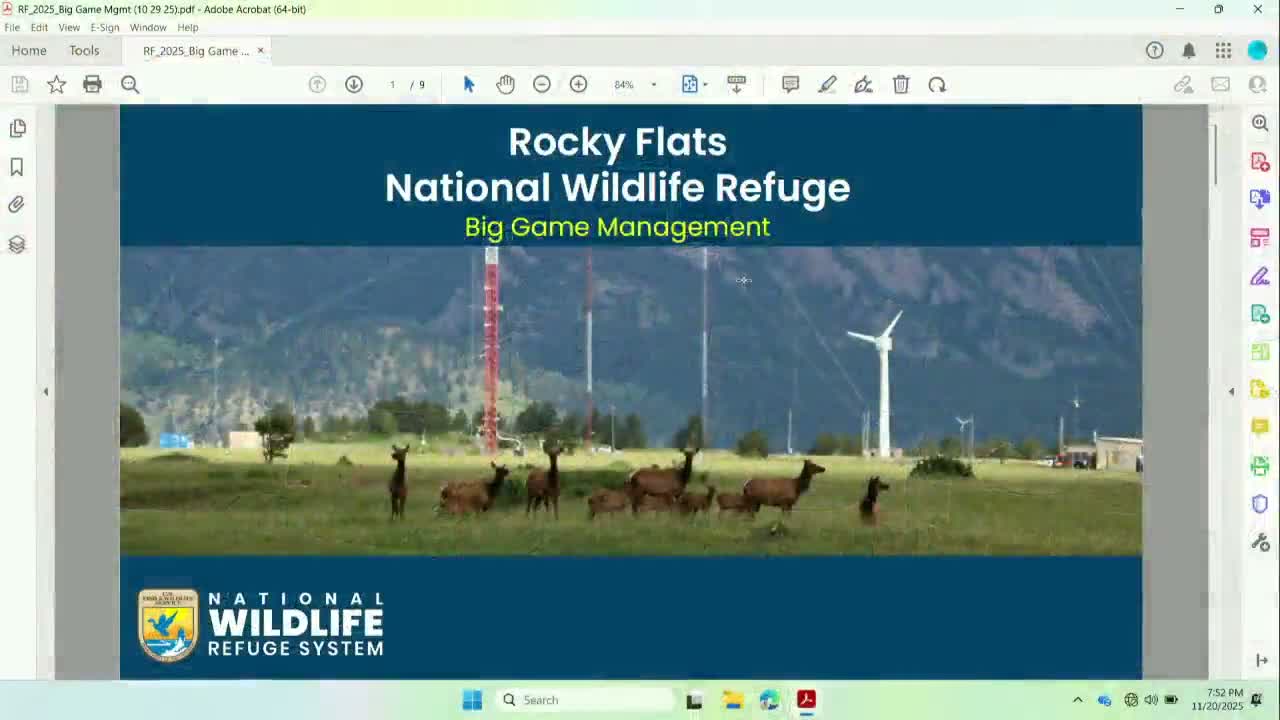
David Lucas, refuge manager and project leader for the U.S. Fish and Wildlife Service, briefed the Boulder County advisory committee on a proposed Hunt Management Plan for Rocky Flats National Wildlife Refuge aimed at reducing an overabundant elk population, improving herd and habitat health and lowering human safety risks.
Lucas said habitat-condition and carrying-capacity analyses indicate Rocky Flats and the larger management unit support more animals than the landscape can sustainably carry. He described monitoring and collaring work that maps elk movement, noted a substantial population shift after the December 2021 Marshall Fire and reported recent survey and sampling efforts. Lucas cited a sampling series that included 15 elk in 2023 (non-detect for chronic wasting disease in that small sample) and a larger sample later that produced an approximate 5% prevalence estimate; he said disease surveillance and herd-health were major drivers of the management proposal.
For safety and ecosystem reasons, Lucas described a multi-step approach: draft refuge-specific regulations (for example prohibiting high-powered center-fire rifles because of proximity to neighbors and infrastructure), coordinate with Colorado Parks and Wildlife for special hunts and tag issuance, and monitor outcomes in an adaptive management framework. He said hunting could be authorized through the planning and rulemaking process starting in 2026 with public hunts listed in CPW materials in 2027, subject to refuge-specific buffers and seasonal restrictions.
POSEAC members and residents asked about the risk of wounding versus clean kills if rifle restrictions are imposed, whether hunting could push animals into roads and increase collisions, wildlife-crossing infrastructure and whether meat or carcasses would be handled by hunters. Lucas said the refuge intends to authorize shotguns, archery and muzzleloaders while restricting long-range high-powered rifles; he emphasized orientation and monitoring and said Colorado Parks and Wildlife procedures require hunters to remove meat (quarters and backstraps) and that the refuge would coordinate retrieval and euthanasia where animals are wounded.
Members of the public asked about residual contamination at Rocky Flats and whether animals had been tested for radionuclides; Lucas said samples collected in 2023 were tested for radionuclides and were non-detect in edible tissues and that the site had prior studies supporting an unlimited-use designation for the refuge. He said history and monitoring information would be included in hunter orientation and the refuge brochure.
Next steps: the multi-agency team will draft a Hunt Management Plan and participate in the federal/state rulemaking process; public comment and additional sampling and monitoring are planned as part of that process.