Get Full Government Meeting Transcripts, Videos, & Alerts Forever!
Get email alerts on the Wildfire Mitigation topic
No spam. Unsubscribe anytime.
Wildfire Partners and county mitigation tax: what POSEAC heard
Summary
Wildfire Partners outlined a countywide mitigation program, funded by a voter‑approved sales tax that raises about $8–9 million annually, featuring home hardening assessments, rebates, grant programs and community chipping; staff said the parcel‑level certification has helped homeowners obtain insurance and reduce risk.
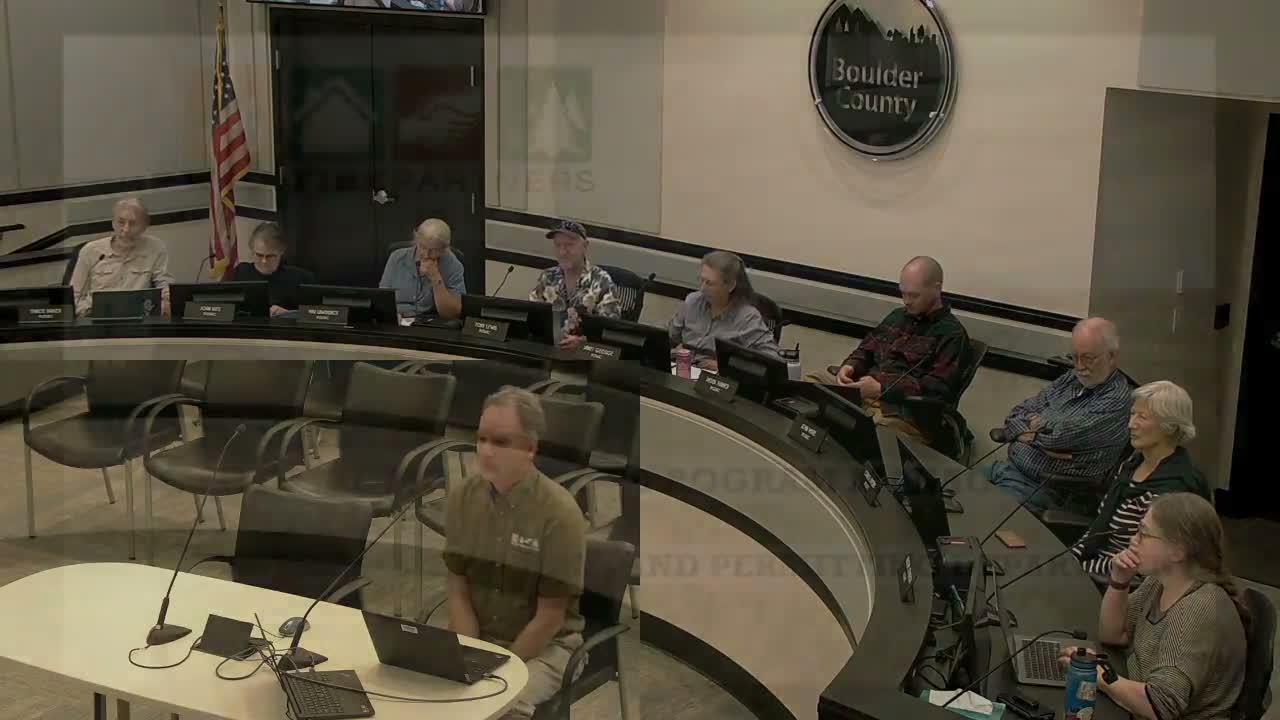
Boulder County’s Wildfire Partners program described its parcel‑level mitigation work to the Parks and Open Space Advisory Committee on Sept. 25, highlighting a mixture of voluntary assessments, rebates and grant programs funded by a voter‑approved wildfire mitigation sales tax.
Jim Webster of the county’s Community Planning and Permitting department said a 2018–2022 series of public surveys and a ballot measure resulted in a mitigation sales tax approved by voters and that fund raises about $8–9 million a year for mitigation work. Webster described a home assessment and certification program that provides customized mitigation recommendations, inspections and recertification; participants submit certificates to insurers as evidence of mitigation work.
Program metrics: Webster said the average household undertaking certification reports roughly $9,000 in mitigation costs and about 103 hours of effort between assessment and final inspection; the average time to certification was 1.2 years. The program conducted more than 3,900 assessments last year and operates rebates, fuel‑reduction grants and community chipping programs to help residents maintain defensible space.
Applicability and partnerships: Committee members asked whether the program applies in urban neighborhoods with small lots. Webster said strategies differ where lot sizes and structure separation are small; mitigation still focuses on ember resistance and home hardening where possible. He also described private‑sector partners — including insurance companies, retailers and realtors — who help recognize certificates and support outreach. Webster said the program was designed with insurer input to ensure credibility and to help homeowners retain or obtain insurance.
Why it matters: County staff framed mitigation as essential given recent large fires and changing climate conditions. The program pairs regulatory building‑code tools for new construction with voluntary, parcel‑level actions for existing homes. Webster said the goal is to reduce ignition risk and improve community resilience.
Next steps: Wildfire Partners continues to deploy rebate and grant programs and expand outreach; POSEAC members and staff discussed how county code and city codes vary and how mitigation strategies must be tailored to different neighborhoods.
"We can't eliminate fire," Webster said. "We adapt and we build communities and we retrofit and harden homes so they can survive a wildfire."