Get Full Government Meeting Transcripts, Videos, & Alerts Forever!
Get email alerts on the Agriculture topic
No spam. Unsubscribe anytime.
Boulder County outlines Working Lands Conservation Initiative to change grazing leases
Summary
Boulder County Parks and Open Space unveiled a Working Lands Conservation Initiative to revise grazing leases with regenerative‑ag practices, per‑lease grazing plans, and expanded ecological monitoring covering thousands of acres; staff said the county will pursue a collaborative, incentive‑oriented rollout over the next two years.
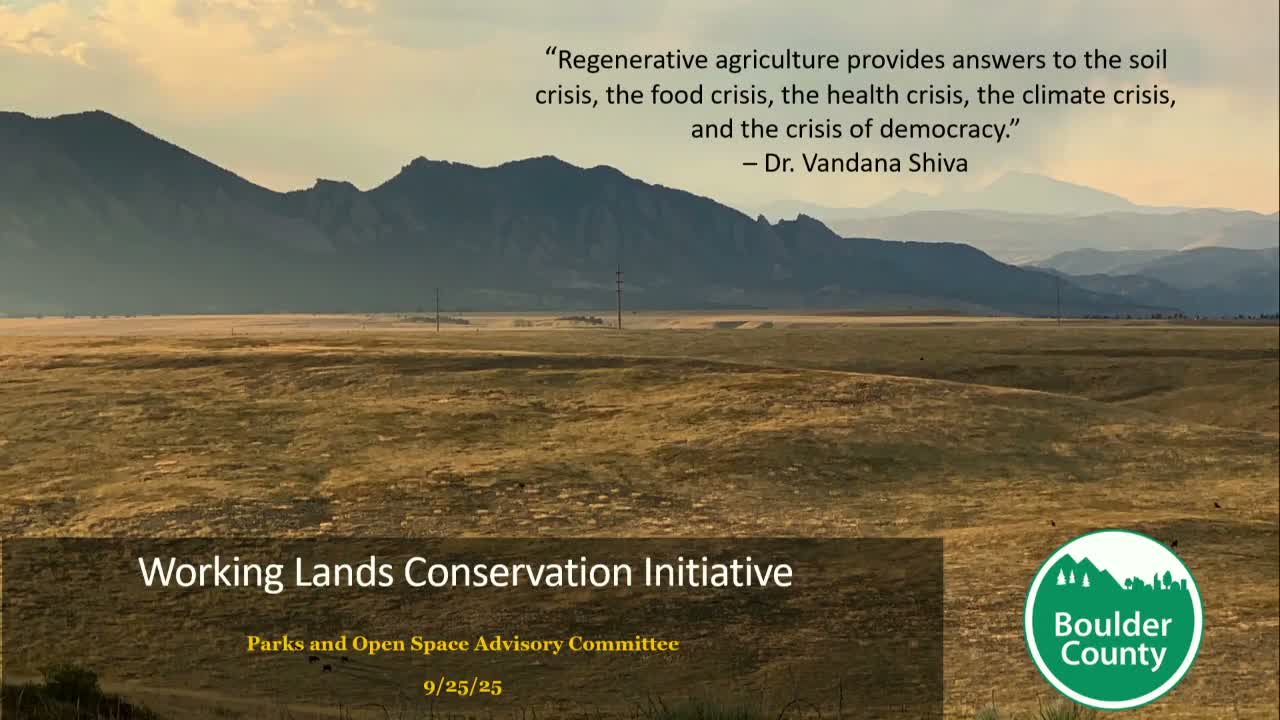
Boulder County Parks and Open Space on Sept. 25 presented a new Working Lands Conservation Initiative that will change how the county manages grazing leases on tens of thousands of acres to prioritize soil health, wildlife habitat and long‑term agricultural viability. Aaron Mayer, senior agricultural resource specialist, told the Parks and Open Space Advisory Committee (POSEAC) the program will insert grazing plans into each lease, set stocking‑rate guidance, and use monitoring to inform adaptive management.
Mayer said the department manages about 26,000 acres — roughly one‑third of the county’s agricultural land — and currently oversees 62 leaseholders with 128 total leases. For grazing specifically, he said 28 grazing leaseholders occupy about 12,259 acres across 81 properties. "Each grazing plan will focus on the 4 or 5 grazing fundamentals — timing, frequency, intensity, duration and rest — and will be simple, actionable and developed with producers," Mayer said.
Why it matters: County staff argued the change is intended to protect grassland bird habitat, reduce erosion, improve soil carbon and water retention, and maintain a working agricultural land base that supports local food security. Mayer cited declines in grassland bird populations and said more active management on county lands can create a mosaic of habitat that benefits species such as mountain plover and burrowing owl.
What staff will do: Mayer said plans will be developed collaboratively with leaseholders and will include monitoring (soil health testing, vegetation sampling and bird point counts). The department plans to partner with CSU Extension, the conservation district and other research programs already operating in the county to collect baseline data and evaluate outcomes. He described a two‑year push to initiate the program and said funding and staff capacity will be required to implement grazing plans across properties.
Questions from committee members focused on enforcement and incentives. POSEAC members asked whether the approach would be a mandate or incentive; Mayer emphasized a trust‑building, collaborative approach rather than unilateral mandates. On lease length, Mayer said longer terms usually foster stewardship but deferred to lease specialists on exact contract language. He also said the county is exploring payments for ecosystem services and grant funding to support riparian fencing or revegetation where needed.
Next steps: Mayer said the department is drafting a written grazing program document and will return with updates; POSEAC members requested the presentation slides and additional written materials. For now, the department will continue outreach to leaseholders while the grazing plan insert language and monitoring design are refined.
"We want a grazing program that is regenerative," Mayer said, adding that the intent is to sustain both agricultural uses and ecological functions on county lands. The Parks and Open Space Advisory Committee received the presentation as informational; no formal vote was required.