Get Full Government Meeting Transcripts, Videos, & Alerts Forever!
Get email alerts on the Municipal Hospital topic
No spam. Unsubscribe anytime.
Dayton officials outline two paths to implement voter-backed hospital levy, warn funds likely insufficient for full hospital
Summary
City law staff told commissioners the 1-mill levy approved by voters will yield roughly $1.9 million a year (about $19 million over 10 years) but likely will not fully fund the level of hospital described in the ordinance; staff recommended public hearings to prioritize which services to fund and presented two administration options: contract with a nonprofit or create a mayor-run governing board.
John Musto, deputy director in the Dayton law department, told the commission the levy passed Nov. 4 with about 58% support and will generate an estimated 1.9 million dollars annually beginning in 2027, producing roughly $19 million over its 10-year term. "Just the construction of the hospital alone will greatly exhaust and greatly exceed the amount of money we're gonna see for the levy," Musto said, arguing that capital, diagnostic equipment and ongoing operating costs would outstrip levy revenue.
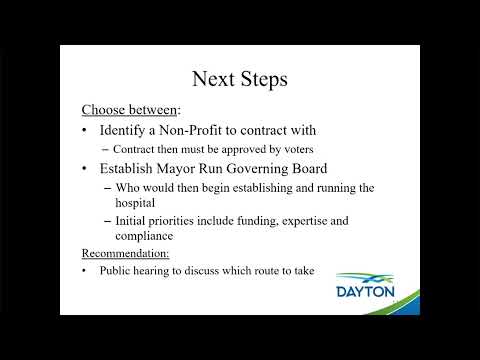
The commission heard two legal administration options. Under one, the city would identify and contract with a charitable nonprofit to build and run the hospital, a path that would require voter approval of the contract at a subsequent election. Under the other, state law allows creation of a mayor-run governing board composed of 11 resident property-owner electors — the mayor would chair and members would serve staggered four-year terms — to manage construction, hiring and governance without an additional ballot measure. Musto said either approach has trade-offs: a nonprofit could bring operational expertise and reduce direct city liability but would require another ballot question; a mayor-run board would avoid a second ballot but could inject politics and face capacity gaps because the city has not run a hospital before.
Musto flagged additional implementation constraints: many patients likely would be on Medicare or Medicaid, which historically reimburses below cost; staffing shortages and higher wages to attract clinicians; and the lack of legal precedent interpreting the relevant chapter of state law for this specific municipal use. He recommended a public hearing in late spring to solicit written and in-person comment so the city can determine which services the public prioritizes and whether phased implementation is feasible. "We need to find out what the priorities are of the citizens," Musto said.
Commissioners pressed staff on accountability and timing. Commissioner Beckham asked when public hearings might be scheduled; Musto recommended late spring. Commissioner Shaw asked how or whether the city would be bound by specific language voters saw on the ballot listing services such as a level 2 trauma center; Musto said the statute contemplates staged implementation and that staff would return with feasible options if the full scope in the ordinance proves financially unattainable. Musto also said the city could accept funds from other sources to augment levy revenue and that any contract with a nonprofit would be structured so the city — by contract — retains oversight.
Public commenters raised overlapping concerns about how levy dollars would be used and whether funds might flow back to existing hospital systems in the region. City leaders said no dollars have been designated yet and that the public process will inform which services to prioritize. The commission did not take a final vote on a governance path at the meeting; staff were asked to return with more detailed options, timelines tied to board-of-elections deadlines, and follow-up legal research.
The next procedural step staff recommended is a public hearing to collect priorities and written comments, followed by more detailed feasibility analysis and a possible ballot schedule if the commission pursues a nonprofit contract.