Get Full Government Meeting Transcripts, Videos, & Alerts Forever!
Get email alerts on the Herbicide Application topic
No spam. Unsubscribe anytime.
Boulder County residents urge commissioners to pause planned drone herbicide application at Red Hill
Summary
Stefan Bridal of Boulder County Parks & Open Space briefed the Board of County Commissioners on a planned drone herbicide application at Red Hill that uses indaziflam and imazapic; multiple residents and local farmers urged the board to pause or reconsider the spray, citing ecological risks, possible conflicts of interest and requests for independent review.
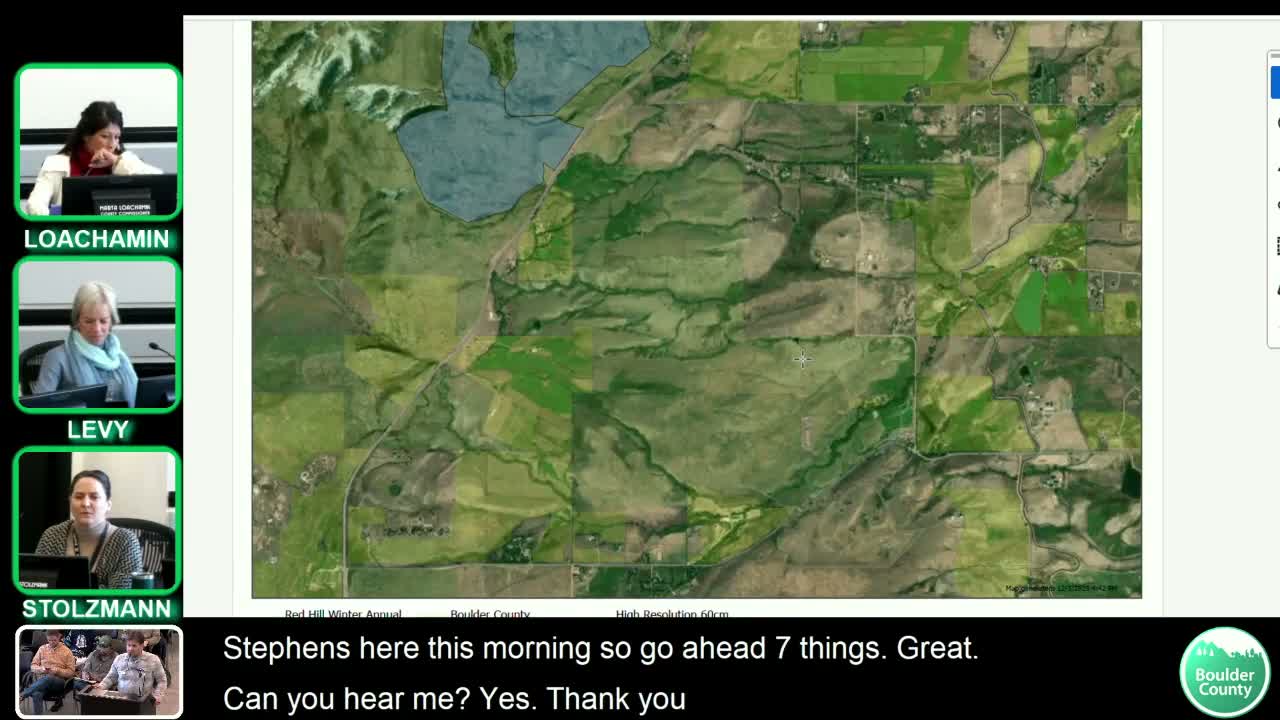
Stefan Bridal, deputy director of Boulder County Parks and Open Space, told the Board of County Commissioners on Dec. 4 that staff plans a drone herbicide application in the Red Hill area as part of the county's integrated weed management plan, last approved on Nov. 8, 2024. Bridal said the chemicals named for the project are indaziflam and imazapic and that applications will follow manufacturer labels, EPA approval, Colorado Department of Agriculture registration and the World Health Organization's hazard classifications.
The issue prompted more than an hour of public comment from farmers, parents and long-time residents who said they oppose aerial spraying. Erin Meschke, a Boulder resident, said a survey she cited showed 81% of respondents opposed drone use and referenced a pro se lawsuit she said involves 22 named plaintiffs and nearly 300 additional individual or group plaintiffs. "Please protect local farms, landowners and consumers and stop this application from happening," Meschke said.
Critics raised three recurring concerns: potential long-term ecological effects of indaziflam, proximity to regenerative farms and private property, and perceived ties between county staff and chemical manufacturers. Janice Hallowell, a 46-year county resident, alleged the county's lead weed specialist has a relationship with Bayer and said, "This would seem to be a conflict of interest and grounds for dismissal of the current plan to spray Rejuvra on Red Hill." Hallowell also said the product label is inconclusive on human safety and asked for independent review before any spraying.
Supporters of nonchemical approaches described grazing and other cultural practices as alternatives. Nick DiDomenico, who said he stewards hundreds of acres near the proposed spray zone, described timed grazing as "a basic solution" and questioned reliance on studies he said were funded by chemical manufacturers. Several commenters, including Hailey Porter, offered to volunteer goats or livestock to reduce cheatgrass.
In his presentation, Bridal described operational safeguards he said the county expects: drone flights flown on programmed paths at low altitudes, use of large-droplet nozzles and a drift-reducing additive, angled spray to push material down, wind limits (no spraying in winds greater than 10 mph) and no spraying during inversions. He said the plan will be reviewed every three years and that final decisions rest with the BOCC.
Commissioners acknowledged the volume of correspondence and public concern. One commissioner estimated they had received about 800 emails on the subject. After public comment, the board agreed to place the matter on the next Tuesday business meeting for fuller discussion and asked staff to provide additional materials, including budget and overlay maps, before that meeting.
Next steps: the board directed staff to schedule the item for the next business meeting so commissioners can review the public input and additional staff information; no formal change to the integrated weed management plan was made at the Dec. 4 meeting.
Sources: Presentation and statements by Stefan Bridal, deputy director, Boulder County Parks and Open Space; public comments by Erin Meschke, Janice Hallowell, Nick DiDomenico and others during the Dec. 4, 2025 BOCC meeting.