SBCC legislative committee reviews embodied-carbon bills and potential workload for performance-based codes
Loading...
Summary
The State Building Code Council legislative committee reviewed bill tracking for embodied-carbon reductions and performance-based building code proposals, discussed timing for testimony and drafting a letter to the full council, and flagged staffing and process impacts; no formal SBCC position was taken.
Members of the State Building Code Council (SBCC) legislative committee discussed a cluster of bills related to embodied-carbon limits and new performance-based code requirements during their Jan. 15 meeting, but the committee did not adopt a formal position and focused on next steps for informing the full council.
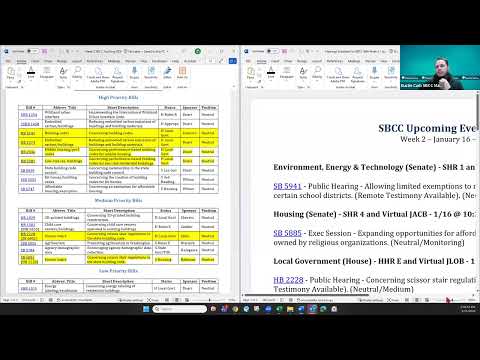
Dustin, staff for the legislative committee, opened the update with the committee’s week-two bill tracking and said the online tracker shows many items moved back to their house and committee of origin. "The interface has changed just a little bit on our Zoom," Dustin said, before summarizing the tracker and noting the committee is "kind of quagmired on the building codes and embodied carbon bills." He flagged bills 1458 and 2273 as carrying targets of about a 30% reduction in embodied carbon for buildings.
Why this matters: several bills under consideration would alter how code requirements for buildings are set or implemented and could expand the council’s technical workload. Committee members raised two procedural constraints: the legislative subcommittee cannot unilaterally speak for the full council and may only provide informative testimony unless the full council votes to adopt a position.
Tom Young, a council member, said when drafting a letter to the full council it would be useful to record dissenting views alongside a majority position so the range of member perspectives is visible. "In drafting a letter ... I think we should also have the other, like, dissenting views," Tom Young said, citing precedent for publishing separate views.
Several members noted timing pressures. Dustin pointed out multiple hearings are scheduled soon and suggested the committee prepare materials so the full council can consider a formal position at its next meeting if needed. Micah said he favors removing detailed technical requirements from statute in HB2273 and leaving those details for rulemaking: "It would be nice to see the council support further removal of technical requirements now," he said, arguing that some specifics are better handled in rulemaking.
Stakeholder input was noted. Tim Attebury of the Associated General Contractors of Washington said he had discussed bill 2141 with Council member Scott Bastini and expected dissent within SBCC on that measure.
On performance-based codes, Dustin described HB2346 (middle-housing performance codes) and related low-rise residential legislation introduced by Representative Dewar, saying they would require the SBCC to convene a technical committee to develop performance-based appendices — an added workload and staffing implication. Roger Haringo said the council has provided information on such impacts in prior sessions and reiterated that forming a technical committee would add work to normal code duties.
What happened next: the committee agreed to prepare materials and talking points for the next council meeting and to monitor hearing schedules; no formal position or vote on policy was recorded at the Jan. 15 subcommittee meeting.