
Perkiomen Valley committee outlines proactive plan to address antisemitism, broaden equity work
Get AI-powered insights, summaries, and transcripts
Subscribe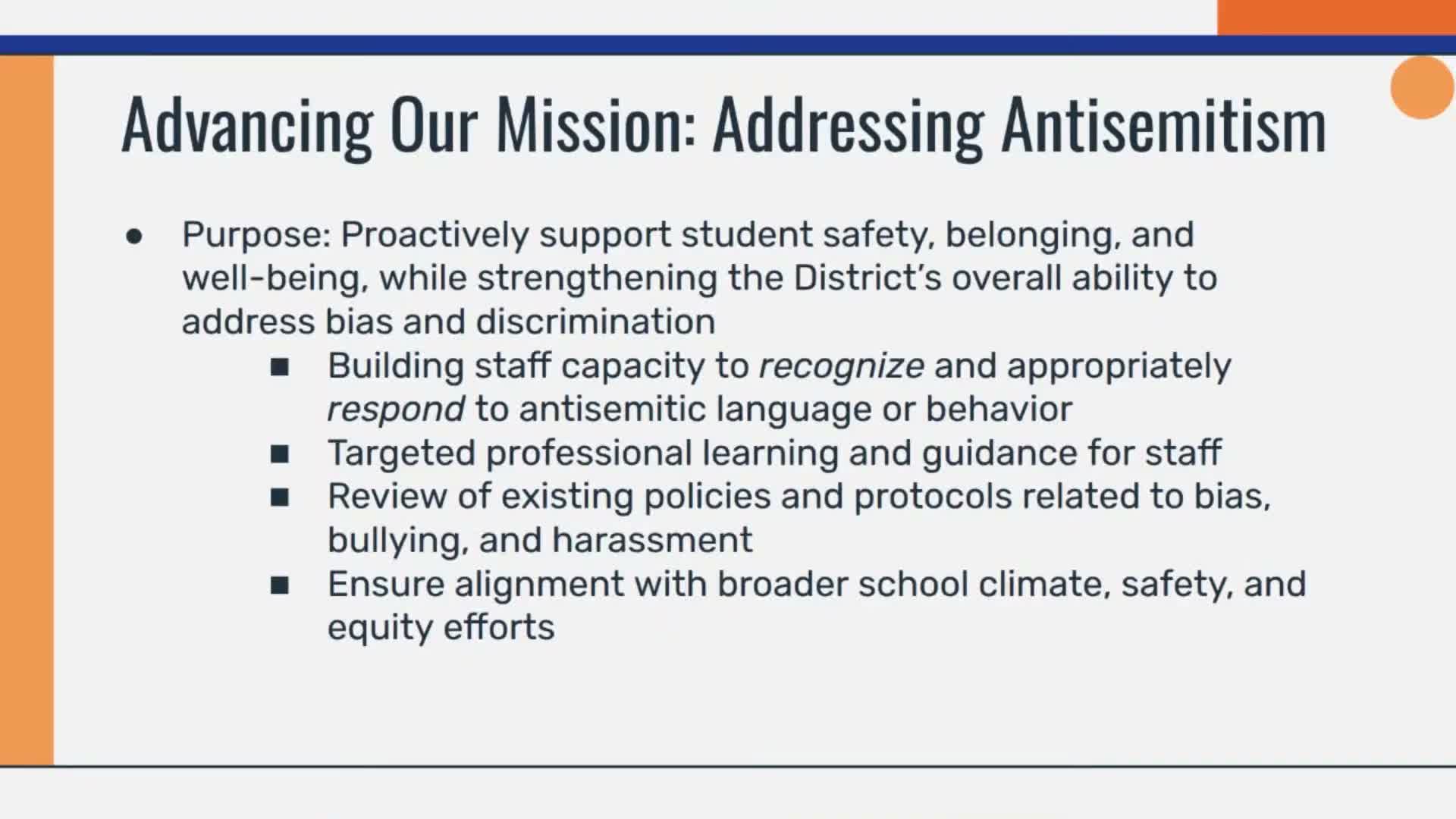
Summary
District administrators described a proactive strategy to train staff to recognize and interrupt antisemitic language and to align that training with existing bias, bullying and harassment policies; outreach to AJC, ADL and local partners is underway.
Doctor Russell, speaking to the Perkiomen Valley School District Education Committee, said the district reopened its Educational Equity Action Plan to add targets and to incorporate recent work on bias and belonging. "First, [we're] looking to build staff capacity to recognize and appropriately respond to antisemitic language, symbols, or behavior," Doctor Russell said, describing professional learning to help staff "recognize" and "interrupt harm" in an age-appropriate way.
Russell said the plan will not stand alone: staff training will be reviewed alongside existing policies on bias, bullying and harassment so responses are consistent. She told the committee she has met with the American Jewish Committee and the Anti-Defamation League’s Philadelphia office and is scheduling a meeting with the Jewish Federation of Greater Philadelphia to develop guidance and training. "They want to help us. They want to educate us," Russell said of the faith-based and nonprofit partners the district has contacted.
Board members pressed on how the district will balance free expression with prohibiting discriminatory speech. One board member asked where the threshold lies between discussing world events and speech that is discriminatory; administrators said the threshold centers on threats, vulgarity, or incitement to violence and that student-expression policy language guides administrator decisions. "The threshold is high," Russell said, adding that school responses are structured by policy and student-safety expectations.
Administrators also described plans to build relationships with community faith leaders, form a faith-based leadership advisory, and to incorporate equity work into existing multi-tiered systems of support (MTSS) and broader school-climate efforts so the work is reinforced across classrooms and not a single initiative.
Next steps: administrators will continue partner outreach, return to the committee with proposed professional learning offerings and policy-review recommendations, and report back on the advisory meetings under development.