Petaluma board confronts $6.1 million in proposed cuts as county demands plan
Loading...
Summary
Petaluma City Schools staff presented a budget plan that would require roughly $6.1 million in reductions, targeting positions added with one-time funds and site allocations; staff said cuts are forced by the end of pandemic funding and rising special-education costs, and the board scheduled follow-up meetings for Feb. 24 and Jan. 27 to finalize details.
Petaluma City Schools officials on Jan. 13 outlined a plan to reduce district spending by just over $6.1 million next fiscal year, saying the action is necessary to respond to the loss of one-time pandemic funds and continued growth in special-education costs.
"This is not something that any of us want to be doing right now," Superintendent Matthew Harris said as he framed the budget shortfall and the countyofficerequirement for a detailed plan. Chief Business Official Amanda Bonner presented multi-year projections that, even after an initial $5 million target, still showed structural deficit spending without additional cuts.
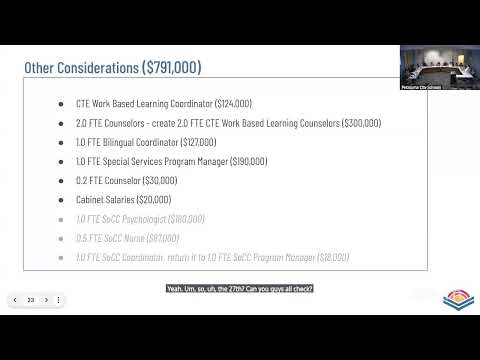
The budget-advisory committee recommended converting positions funded temporarily by restricted or one-time dollars back to a non-recurring status and removing them from the ongoing general fund. That list included 9.0 full-time-equivalent student advisers, one full-time nurse shown as a remaining one-time funded position, two assistant principals at K-8 sites, a school psychologist and other roles added during pandemic- and grant-funded years. The committee also proposed reducing site discretionary allocations by 25%, restructuring alternative-education staffing, and changing the secondary bell schedule to reduce required sections.
Amanda Bonner said the committee reached those recommendations after multiple meetings and that the final savings will depend on enrollment projections and contract constraints. "We often talk about needing to maintain a 3% minimum reserve," Bonner said; she added the committee recommends aiming higher to avoid repeated, year-to-year cuts.
Teachers, nurses and program staff urged the board to preserve student-facing roles. "Agency nurses cost around a $100 an hour," school nurse Monica Cavallo told the board, warning that relying on agencies would narrow services for students with medical needs. School nurse Kristen Bianchi noted legal obligations: "Students are legally required to attend school... In turn, schools are legally obligated to provide the health services necessary to ensure safe attendance." Several speakers asked the district to pursue outside funding or partnerships to keep nurses and mental-health clinicians.
Board members asked staff to return with more specific position lists and policies that could be used to prioritize restorations if new funds arrive. The board set an additional meeting to continue budget work on Jan. 27 at 5:30 p.m. and agreed to bring specific personnel recommendations back in February so the county budget officecan reassess the district's budget certification.
The presentation also included an explanation of recent audit findings (procurement of nonpublic-school services, attendance accounting and a summer-program hour requirement) and an update on developer-fee accounting and capital-facility contracts the board approved earlier in the meeting. The district reiterated that failure to present a credible plan could lead to more severe fiscal oversight by the county.
Next steps: staff will bring a detailed list of positions and proposed policy language to the board in February, with the budget-advisory group prioritizing jobs that could be restored if one-time or new restricted funds become available.