Soledad council presses for local policy after Flock Safety presentation on license‑plate readers
Loading...
Summary
Council heard a detailed demonstration from Flock Safety and the Soledad Police showing cases solved with license‑plate readers, while also pressing staff for enforceable local policy, bilingual community outreach and public transparency to address immigration and privacy concerns.
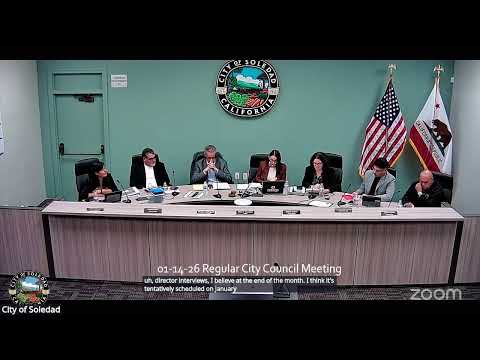
Soledad officials spent much of their Jan. 14 meeting focused on license‑plate reader technology after a presentation from Flock Safety and the city police, highlighting how the cameras are used in criminal investigations while laying out new city follow‑ups on policy and public outreach.
Trevor Chandler, director of public affairs for Flock Safety, told the council the system ‘‘does not replace officers, it multiplies them’’ and described features the company says improve investigations, including a vehicle ‘‘fingerprint’’ capability and integrations with national hot lists. Lieutenant Arriola, who described how six existing cameras helped locate suspects in cases ranging from bank robbery to violent incidents, said the technology ‘‘gives us eyes in places we physically can't be, 24 hours a day.’’
Why it matters: council members and staff pressed for clear limits after recent controversies elsewhere about police‑technology data sharing. Several members said the city must provide residents—particularly immigrant and low‑income communities—clear, enforceable policies and bilingual explanations about who can access LPR data, how long records are retained, and whether federal agencies can obtain information.
Flock and police officials responded with technical and contractual assurances. Chandler said Soledad ‘‘owns 100% of its data’’ and that Flock ‘‘will never sell it, period,’’ and noted the company’s default retention is 30 days. He also said the vendor disabled features that would allow California agencies to share data with agencies outside the state or with federal partners, and that audit logs and an offense‑type dropdown (tied to NIBRS codes) are being used to flag or trace potential misuse.
Council response and next steps: despite those assurances, multiple council members urged staff to draft a local policy that consolidates relevant state rules (the Values Act and related statutes), the city’s contract terms, and local limits on sharing or retention. The council directed the city manager and city attorney to examine existing code and policy, to return with recommendations, and to begin community outreach (including an English/Spanish short video and posted transparency materials) to explain how the cameras are used and what protections are in place.
What officials did not do: the council did not vote to expand the camera network during the meeting; members said any future expansion would return as a separate contract item for Council approval. Chandler and the police said training for officers is required before use, that only authorized personnel may run searches, and that evidence hits—downloaded into the department’s files—leave the Flock system only for law‑enforcement evidence purposes.
The council scheduled follow‑up work: staff will report back with recommended policy language and public‑education materials in upcoming meetings so residents can see the city’s limits and safeguards.