
Superintendent reports sharp drop in out‑of‑school suspensions, ties change to equity audit and restorative practices
Get AI-powered insights, summaries, and transcripts
Subscribe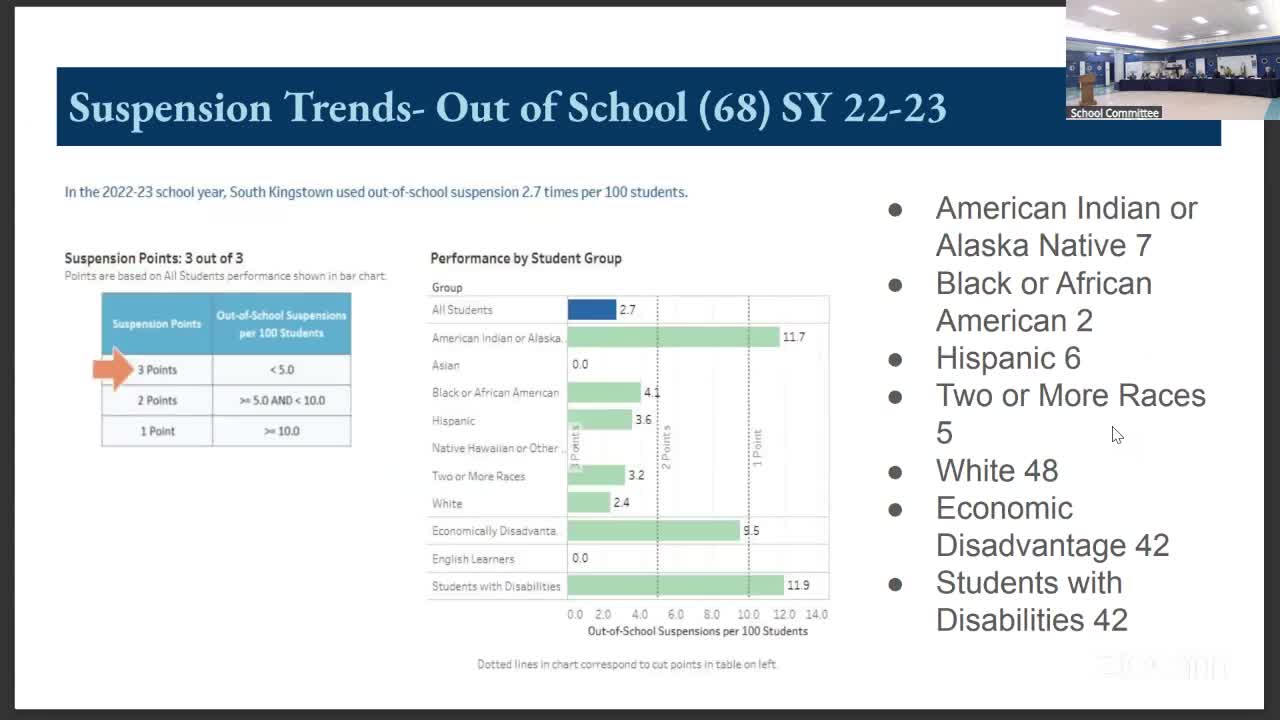
Summary
Superintendent Perdosa presented a three‑year suspension analysis showing a roughly 43% drop in out‑of‑school suspensions and outlined changes—equity audit work, restorative practices, revised workflows and professional development—that the district credits for the trend; the committee approved administration of the Rhode Island student survey for grades 6–12.
Superintendent Mr. Perdosa told the School Committee the district has seen a notable decrease in out‑of‑school suspensions over the past three years and presented district‑level, disaggregated data in compliance with Rhode Island reporting requirements.
Perdosa said out‑of‑school suspension incidents fell by about 43% from the 2022‑23 school year to last year, declining from 68 incidents to 35 and dropping the district rate from 2.7 to 1.7 incidents per 100 students. He listed subgroup counts for the 2023‑24 year (for example: Black/African American students 9; Hispanic students 11; students with disabilities 33) and stressed that some disproportionality remains for particular subgroups.
When asked whether the decrease reflects actual behavior change or a change in discipline practice, Perdosa said several factors likely contributed: the equity audit and related data work, a shift toward in‑school suspensions in some cases, expanded professional development on de‑escalation and restorative practices, targeted behavior‑management workflows at specific schools, use of a gap‑closure coach and curriculum adjustments. "Bringing that data to light... and having those conversations... caused some reflection and caused some changes in behavior," he said.
The superintendent emphasized the district presented only district‑level figures at the public meeting to avoid potential identification of individual students at small‑N schools; he said more granular school‑level analyses are done by administrators outside of open public meetings to protect privacy.
Committee members praised the direction and asked for clarification on how in‑school suspension is supervised and how students remain academically engaged; Perdosa described in‑school suspension as supervised work time, often run by a substitute or teaching assistant, with work provided and teachers able to check in.
The committee voted to approve administration of the Rhode Island Department of Education/Department of Health student survey for grades 6–12, which Mr. Perdosa said is an electronic, randomized questionnaire administered during the school day; he noted district‑only disaggregated output is not typically provided but said he could ask whether special access is possible.
Next steps: the district will continue professional development and targeted interventions; the superintendent and administration will monitor suspension trends and report back, and the approved student survey will be arranged with school principals for district participation.