Get Full Government Meeting Transcripts, Videos, & Alerts Forever!
Get email alerts on the Office On Disability Report topic
No spam. Unsubscribe anytime.
San Francisco ODA reports 107 ADA grievances, flags ASL shortfalls and shelter-policy wins
Summary
The Office on Disability and Accessibility reported 107 ADA grievances in the first half of the year—most involving curb ramps or the public right of way—and flagged gaps in ASL interpretation coverage. The agency highlighted one grievance that secured housing on discharge and staff training at a shelter.
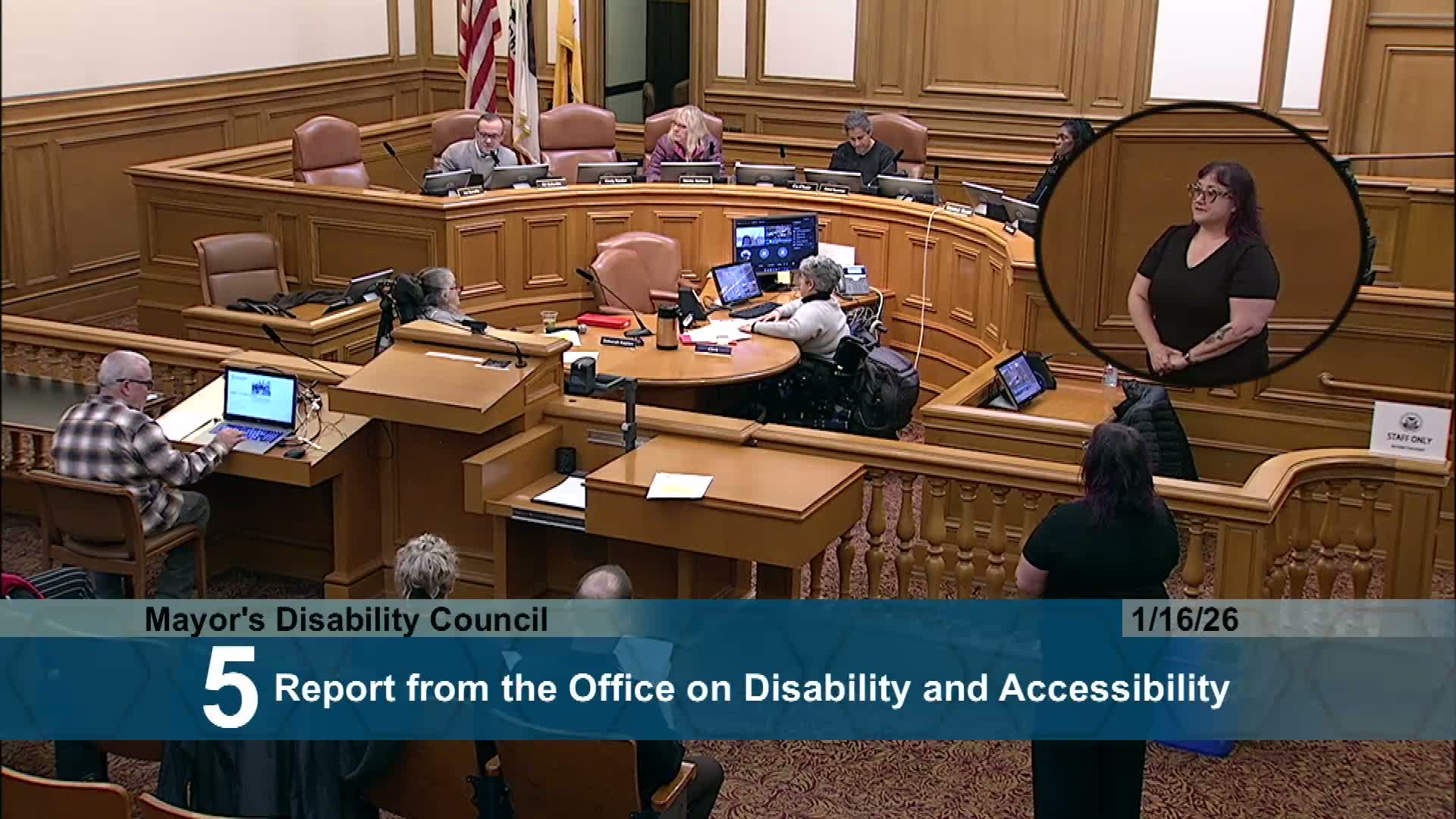
Eli Gellardan, director of the Office on Disability and Accessibility, told the Mayor's Disability Council on Jan. 16 that the office logged 107 ADA grievances across the city in the first half of the year, with the bulk involving public right-of-way and curb ramps.
"We have seen over the first half of the year, 107 grievances, complaints, ADA complaints across the city," Gellardan said, and he said nearly 60% of those concerns involved curb ramps or public right-of-way deficiencies.
The director also outlined language-access challenges, saying ODA will issue a 2026 report on ASL interpretation. "In the first half of the year, we saw approximately 5 requests with less than 72 hours of notice. We were able to fill 2 of those, so that meant 3 of those requests or 60% went unfulfilled," he said, adding that of 21 requests with 72 hours' notice or more, 8 were filled and 13 went unfilled.
Gellardan presented a case study to show how the grievance process can resolve access problems. He described an individual who was repeatedly evicted from temporary housing while hospitalized because the shelter required residents to return within seven days. After a Title II ADA grievance, the shelter agreed to a reasonable modification, secured housing for the individual on discharge and implemented staff training; the resolution included local and federal appeals options.
On policy, Gellardan summarized federal and state developments of interest to the council: HR 1634, the Think Differently About Disability Employment Act, remains in the congressional pipeline; the state-level SB 84 (a recurring disability access "opportunity to cure" bill) continues to be introduced; and locally the mayor's Safe Streets Executive Directive will form a multi-agency working group on street safety and resilience.
Gellardan closed by asking the council to stay engaged on planned ODA projects including an ADA grievance and self-evaluation pilot, an accessible tourism initiative tied to upcoming large events, and ongoing outreach around emergency preparedness for people who rely on powered medical equipment.
The council did not take formal action on any ODA recommendations at the meeting; staff encouraged public engagement via oda@sfgov.org.