Get Full Government Meeting Transcripts, Videos, & Alerts Forever!
Get email alerts on the Zoning Abundant Life topic
No spam. Unsubscribe anytime.
Neighbors press Matthews commissioners over church expansion; hearing continued to March 9
Summary
Residents told the Matthews Board of Commissioners that a proposed expansion of Abundant Life Church would worsen flooding, remove mature trees and increase noise and light; church and staff described stormwater and buffering plans. The board continued the public hearing to March 9 to allow further neighbor meetings and follow-up on technical issues.
Pastor Brent Watts and the engineering team for Abundant Life Church asked the Matthews Board of Commissioners on Jan. 12 to approve a rezoning that would allow the church to increase seating above the town’s 400-person threshold and expand parking and building area at 3321 Matthews Mint Hill Road.
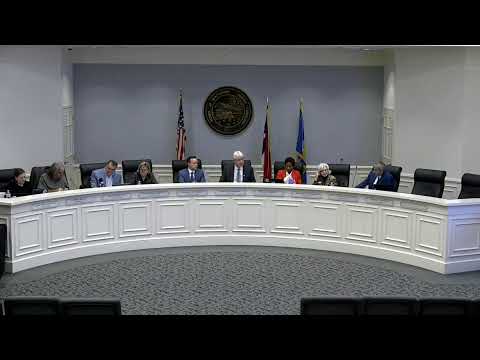
Neighbors and several commissioners, however, pressed for more concrete mitigation after an extended technical presentation on stormwater, parking and site design. The board voted 5–1 to continue the public hearing to March 9 to give the applicant and staff more time to work with nearby residents and provide additional details.
Why it matters: The application would change the site’s zoning to permit a larger congregation, add roughly 60 parking spaces above the UDO minimum and create more impervious surface on a property residents say already contributes to backyard flooding. Neighbors said the proposal would reduce mature tree cover, increase light and noise and strain local traffic on Highway 51.
What the applicant told the board: Pastor Brent Watts, who has led Abundant Life Church for 19 years, said the expansion responds to rapid growth and projected needs. Engineer Jeff McCluskey said the revised site plan moves the proposed building 21 feet to meet a 50-foot setback, relocates dumpsters away from property lines, removes a playground and adds an opaque (non-see-through) fence and enhanced plantings. On stormwater, McCluskey said the plan includes catch basins, a sand-filter water-quality component and a detention pond sized to meet the town and Mecklenburg County requirements for events up to the 50‑year storm.
On parking, McCluskey and the pastor said the church’s seat-to-parking experience drives the proposal: “We currently have 105 parking spots and 200 seats,” Pastor Watts said, adding that multiple Sundays have filled all available spaces. The town’s Unified Development Ordinance requires 133 spaces for the baseline; the applicant proposed about 191.
Neighbors’ concerns and requests: Multiple residents described repeated flooding in yards, loss of mature tree buffers from earlier expansions and new impacts they expect from larger HVAC units, more lighting and the enlarged parking area. Beth Folick, whose home backs onto the church property, told commissioners: “This rezoning should not be allowed at our expense,” citing flooding, tree loss and traffic. Forest Brook Estates HOA representative Barbara Simpson said an analysis of the submitted tree survey indicated substantial tree removal and asked the board to require enforceable conditions: “We respectfully ask the board not to approve this rezoning without some enforceable conditions addressing these issues.”
Staff and technical context: Town staff (Darren Hallman) and town engineer Susan Habino Wheeler explained that the project’s trip-generation numbers did not trigger a traffic‑impact analysis under the town’s thresholds because the predicted peak‑hour trips fall below the ordinance trigger. Staff noted the applicant submitted conditional notes, a tree survey and adjusted elevations for future phases. Staff also explained that NCDOT has done preliminary engineering on the nearby road project but has not funded the work; DOT told staff it would not permit a driveway relocation without property acquisition or future-median changes.
Board action and next steps: After hearing applicant and neighbor testimony and extensive technical questioning about stormwater management, lighting, HVAC placement and tree preservation, the board voted to continue the public hearing to March 9. Commissioners asked the applicant to meet directly with neighbors during the continuance, provide clearer, enforceable mitigation commitments where feasible, and follow up with staff on outstanding technical points (stormwater discharge routing, the engineered elevations for phase 2, and potential noise/lighting controls). Pastor Watts asked the council to balance the church’s regulatory obligations with neighbors’ concerns but agreed to continue working with staff and residents.
What’s next: The public hearing remains open; the board will revisit the application on March 9. The continuance preserves the record and gives staff, the applicant and neighbors time to provide additional documentation and possible enforceable conditions for the commissioners to consider.