Santa Ana Arts Commission forms ad hoc committee to refresh decade‑old master plan
Loading...
Summary
The Santa Ana Arts and Culture Commission on Jan. 15 agreed to form a three‑member ad hoc subcommittee to produce a roadmap for updating the city’s 2016 Community Arts and Culture Master Plan, focusing on funding, staffing and community engagement; staff set a six‑month target for a draft to return to the commission.
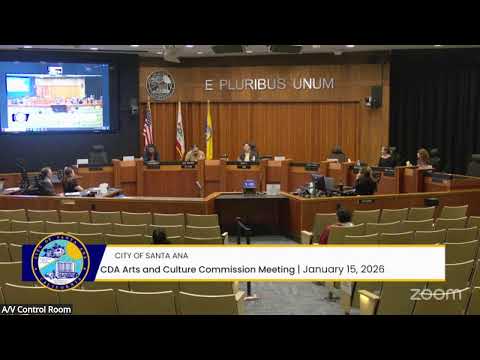
The Santa Ana Arts and Culture Commission agreed on Jan. 15 to form an ad hoc subcommittee to guide a refresh of the city’s Community Arts and Culture Master Plan, originally adopted in 2016.
Staff member Tram told commissioners the 2016 plan — developed by the Cultural Planning Group as a 10‑year roadmap — established eight goal themes including cultural equity, infrastructure, the creative workforce, community access, youth programs, spaces and placemaking, and public art. “This is the final year of that plan, so it’s the right time to move on to an update,” Tram said during the meeting.
Commissioners debated whether to write an entirely new plan or to start from the 2016 document and identify unmet objectives. Commissioner [Bermejo] volunteered for the ad hoc; the chair and Commissioner Russell also committed to serve. Tram said the subcommittee’s charge is to build the roadmap for updating the plan — not to complete the entire plan itself — and recommended a six‑month timeline for producing a draft the commission could discuss and then forward toward City Council for adoption, with a target implementation date of January 2027.
Commissioners pressed for clear, implementable recommendations, not only aspirational goals. “Staffing, funding and facilities are the things I don’t see how one person can do alone,” one commissioner said, urging that the refresh include specific steps for staffing and long‑term funding. Commissioners discussed community‑engagement options including in‑person meetings at community centers, online surveys and targeted outreach to past grantees; Tram said the city has some recent survey data that can inform the process.
The commission also discussed consultant support. Some commissioners argued that a full rewrite would likely require hiring outside consultants to conduct broad stakeholder research and convene community sessions; others said the ad hoc could chart an approach that blends review of existing materials with targeted outreach.
The ad hoc subcommittee will finalize meeting logistics with Tram after the session. Tram also told commissioners staff would coordinate community‑engagement plans and begin compiling existing survey results to inform the subcommittee’s first meeting.
Next steps: the ad hoc will meet to draft a roadmap for the refresh and report back to the full commission; commissioners said they will advocate for the staff and funding needed to carry recommendations into implementation.