
OSTP director outlines AI action plan and 'Genesis' mission as central federal priorities
Get AI-powered insights, summaries, and transcripts
Subscribe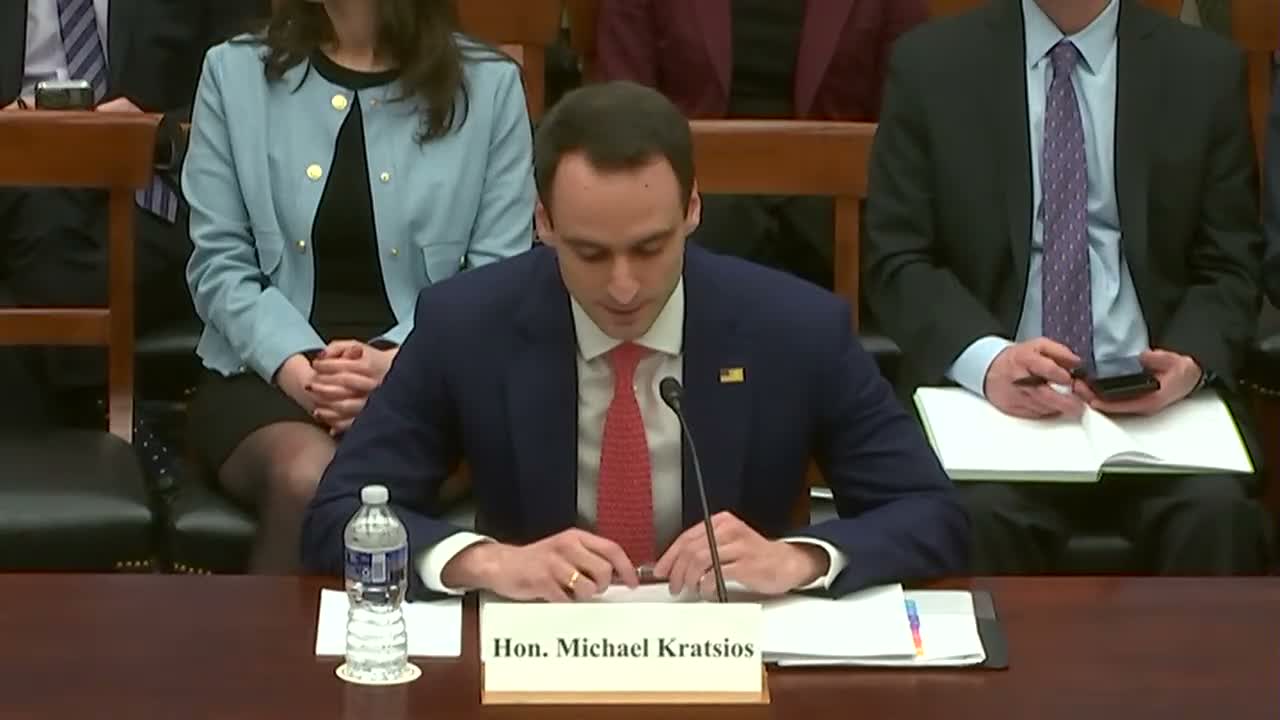
Summary
White House OSTP Director Michael Kratios told the House Science, Space, and Technology Committee that the administration has moved from AI strategy to execution, highlighting a three‑pillar AI Action Plan and the Genesis mission to accelerate scientific R&D using federal datasets and supercomputing.
Michael Kratios, director of the White House Office of Science and Technology Policy, told the House Science, Space, and Technology Committee that the administration has moved from strategy to execution on its AI Action Plan, which he described as built around three priorities: “innovation, infrastructure, and international partnerships.”
Krátios said the administration’s next big step is the Genesis mission, a government effort to fuse federal scientific datasets with advanced supercomputing to “automate experiment design, accelerate simulations, and generate predictive models” for fields from medicine to energy. “The Genesis mission’s goal is to double the output of U.S. research and development in a decade,” Kratios said.
Committee leaders from both parties pressed Kratios on how the plan will be implemented. Chairman Oberonolte and full committee Chair Rep. Babin said federal leadership is needed to avoid a patchwork of state laws and to expand access to computing resources at national laboratories. Babin highlighted DOE supercomputing assets such as Frontier, Aurora and El Capitan as central to those efforts.
Ranking Member Lofgren and other Democrats acknowledged innovation goals but urged stronger guardrails for risks such as manipulated imagery and other harms. Kratios responded that OSTP will work with Congress on a “sensible national policy framework” and with Commerce and agencies to define areas where states should retain authority. He said an executive order and an April 2025 OMB memo provide interim procurement and implementation guidance while legislative work proceeds.
Krátios characterized the administration’s approach as focused on standards, model evaluation and expanded computing infrastructure, and urged Congress to codify durable institutions that survive changes in administrations. He identified energy capacity, including small modular reactors and other power sources, as a key constraint for data center expansion and AI infrastructure.
The committee left the record open for 10 days for follow‑up questions and additional comments.