Get Full Government Meeting Transcripts, Videos, & Alerts Forever!
Get email alerts on the Accessory Living Units topic
No spam. Unsubscribe anytime.
Fairfax committee reviews changes to accessory living unit rules to encourage supply and reduce barriers
Summary
County staff presented a menu of changes to Fairfax ALU rules — including removing a separate administrative permit, reconsidering renewal and land-record requirements, and easing size, lot and occupancy limits — while supervisors pressed for stronger enforcement, parking safeguards and clear outreach.
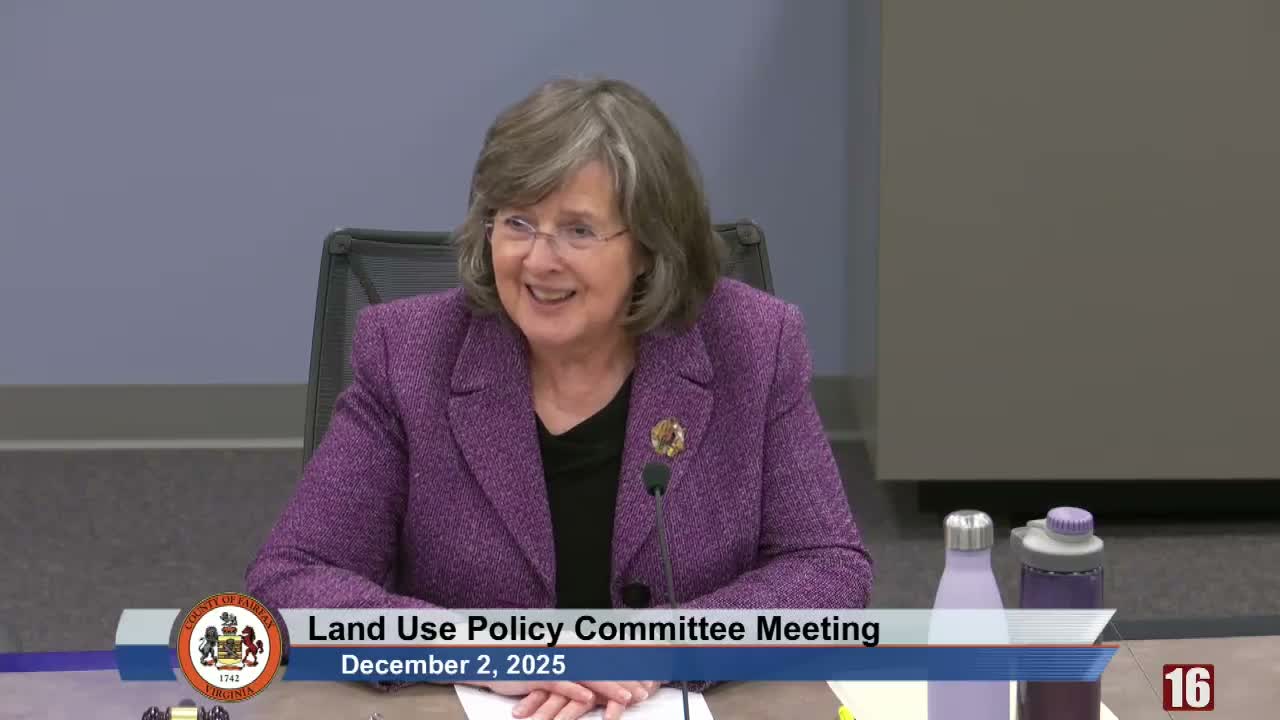
County staff presented a broad set of potential changes to Fairfax County’s accessory living unit (ALU) rules at a Land Use Policy Committee meeting, arguing the updates could increase housing options while committee members raised enforcement and neighborhood-character concerns.
Casey Judge of the Zoning Administration Division framed ALUs as “a great tool in the housing affordability toolkit, because they can help serve to increase the housing supply,” and summarized existing Fairfax standards: ALUs are subordinate secondary units allowed only with detached single-family homes, limited to two people and two bedrooms, with interior units capped at 800 square feet or 40% of the dwelling and detached units capped at 1,200 square feet. Judge said the county requires an initial administrative or special permit (renewed after a two-year initial period, then every five years) and an additional off-street parking space for ALUs.
Staff recited implementation figures and trouble spots. According to staff, about 203 administrative ALU permits have been approved since 2021, with 134 currently active and 69 that lapsed after the initial two-year period; 24 special permits were approved (13 for interior modifications and 11 for detached units). Staff added that complaints tied to ALUs have been rare: “we looked at complaints filed on properties with approved ALUs…only one was investigated that related to a property with an ALU,” staff said.
To reduce permitting barriers and the need for frequent case-by-case zoning interpretations, staff proposed a menu of options for the committee to consider: keep and refine the separate administrative permit (for example, extend or remove the renewal cycle), or eliminate the separate permit in favor of a certification form submitted with building permits (no renewal and lower or no separate fee). Staff also proposed removing the 05/10/2023 date restriction that allowed the entire basement to qualify as an ALU only if existing by that date; reconsidering the requirement to record approvals in land records; and adding clearer definitions, graphics and a “semi-detached” category that would set administrative versus BZA review pathways based on connection length.
On detached units, staff offered options such as allowing administrative approval in defined circumstances, changing the 1,200-square-foot cap to a percentage of the principal dwelling (for example, 50%), or allowing the Board of Zoning Appeals to modify the cap. Staff also flagged potential changes to allow interior ALUs in attached homes, to raise occupancy limits (three or four people or counting adults only), to remove the owner-occupancy requirement, and to reconsider the additional parking-space mandate.
Committee members generally supported revisiting the rules but pressed staff on enforcement and neighborhood impacts. One member asked which changes would make zoning enforcement harder; staff acknowledged enforcement is largely complaint-driven and that the renewal process has not included automatic inspections. Another common concern was permitting ALUs in townhome or multifamily settings where parking and common walls could create problems: a committee member said allowing ALUs in such settings “gives me a lot of pause, mainly because I have never represented a townhome community…that ever said we have so much extra parking.”
Supervisor Alcorn asked staff to include the white paper’s numbers and jurisdictional comparisons in outreach materials and to investigate why 69 permits lapsed, noting the importance of context for public engagement. Deputy County Executive Jennifer Miller urged pairing ALU changes with broader housing-supply strategies, saying the Housing Task Force analysis shows that “the only big things that move the needle is density and additional supply,” and cited Long Beach, California, as an example where ALUs make up a significant share of housing stock.
Staff outlined next steps: present concepts to the planning commission’s land use process review committee later in the week, start community outreach in the new year, draft amendment text for committee review in spring or summer, continue outreach, and aim for authorization and public hearings by year-end. The committee accepted the minutes from its previous meeting and adjourned.
What happens next: staff asked committee members to submit feedback before the holidays so outreach materials can be adjusted; the committee will see refined draft language after outreach and additional committee review.