Get Full Government Meeting Transcripts, Videos, & Alerts Forever!
Get email alerts on the Bond Prioritization topic
No spam. Unsubscribe anytime.
Fairfax park leaders outline 2026 bond priorities and trade‑offs for rec centers
Summary
Fairfax County Park Authority leaders told supervisors they will use data tools and a draft 'bag of rocks' prioritization to allocate roughly $180 million in capital needs, with staff warning one bond cycle will not cover large rec‑center projects such as Audrey Moore, Franconia or Providence.
Jay Cole, executive director of the Fairfax County Park Authority, told the Board of Supervisors on Dec. 16 that staff are preparing a data‑driven package of park projects and a bond timetable aimed at a 2026 ballot measure.
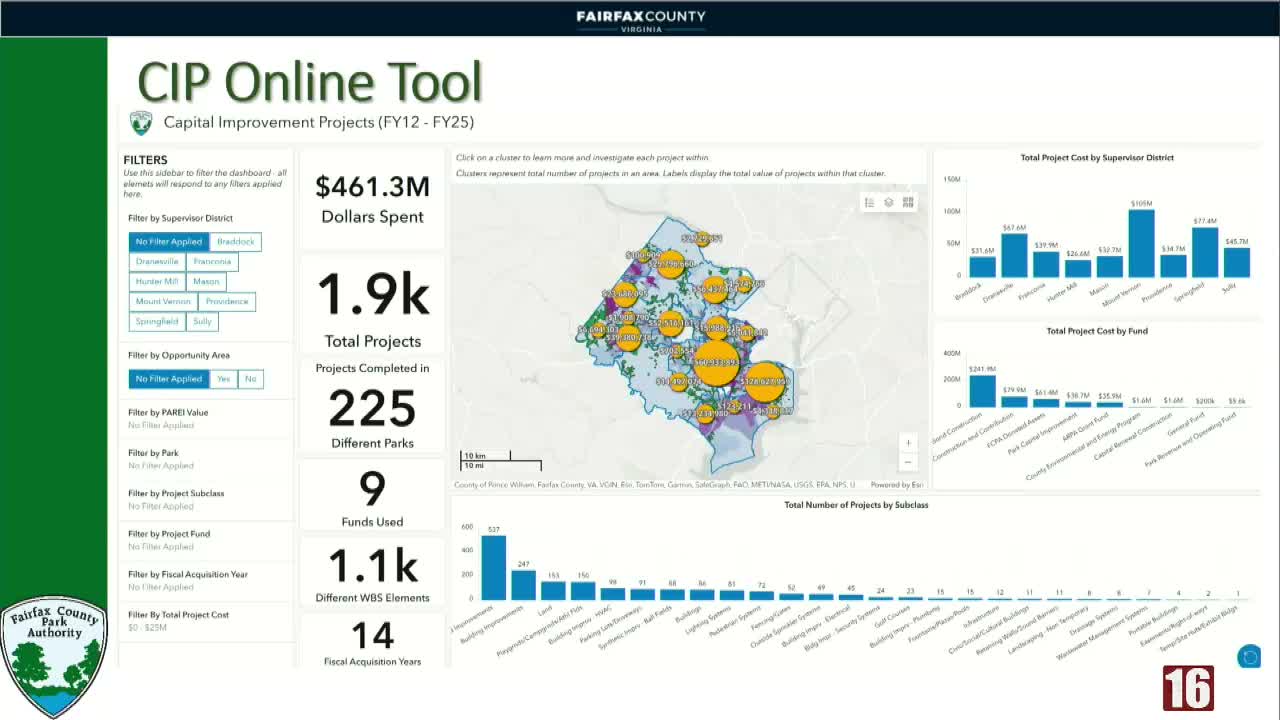
Cole said the authority has developed mapping and scoring tools — including the Capital Improvement Program (CIP) online map, the PROSA access strategy and a Park Authority Racial Equity Index — to guide how limited bond dollars are spent. Using a visual “bag of rocks” metaphor, Cole and staff described roughly $180 million in prioritized capital needs that will force trade‑offs between large projects such as rec‑enter replacements and smaller, distributed improvements.
The Park Authority and staff said the timeline is: public engagement in about April 2026, a Park Authority Board vote in late spring, a Board of Supervisors vote in June and placement of a bond referendum on the November 2026 ballot. Kyle Stone, chair of the Park Authority Board, and Nigel Fields, deputy director for planning and development, said staff will return with a final package after additional community outreach and project costing.
Several supervisors asked for clarity about specific rec centers. Supervisor Lusk pressed staff on whether Providence and Franconia could both be funded; Cole responded that, given the scale of the prioritized work and current cost estimates, ‘‘there’s just not going to be enough’’ in a single bond to do both and that Franconia is currently favored in part because it can be renovated in sections without full demolition. Cole said rising material and construction costs since the COVID‑era are a major driver of higher estimates and that the authority is exploring cost‑reduction options including bulk purchasing, refined design‑bid approaches, or an independent review of regional cost drivers.
The presentation also flagged a particular large project commonly referred to in the presentation materials (spelled variously in the transcript as Audemore/Audre/Audie Moore). Staff identified that big rec‑center projects expand rapidly in cost and that, with fixed bond capacity, staff expect some projects will be treated as a category (‘‘rec centers’’) in future bond cycles rather than single‑site line items.
What’s next: staff will continue project cost estimates and public engagement in spring 2026; the Park Authority Board is expected to vote on a recommended bond package before the Board of Supervisors’ June review ahead of a November referendum.