Get Full Government Meeting Transcripts, Videos, & Alerts Forever!
Get email alerts on the Federal Budget And Social Services topic
No spam. Unsubscribe anytime.
County advisers warn federal HR 1 changes could shift hundreds of millions in SNAP and Medicaid costs to Fairfax
Summary
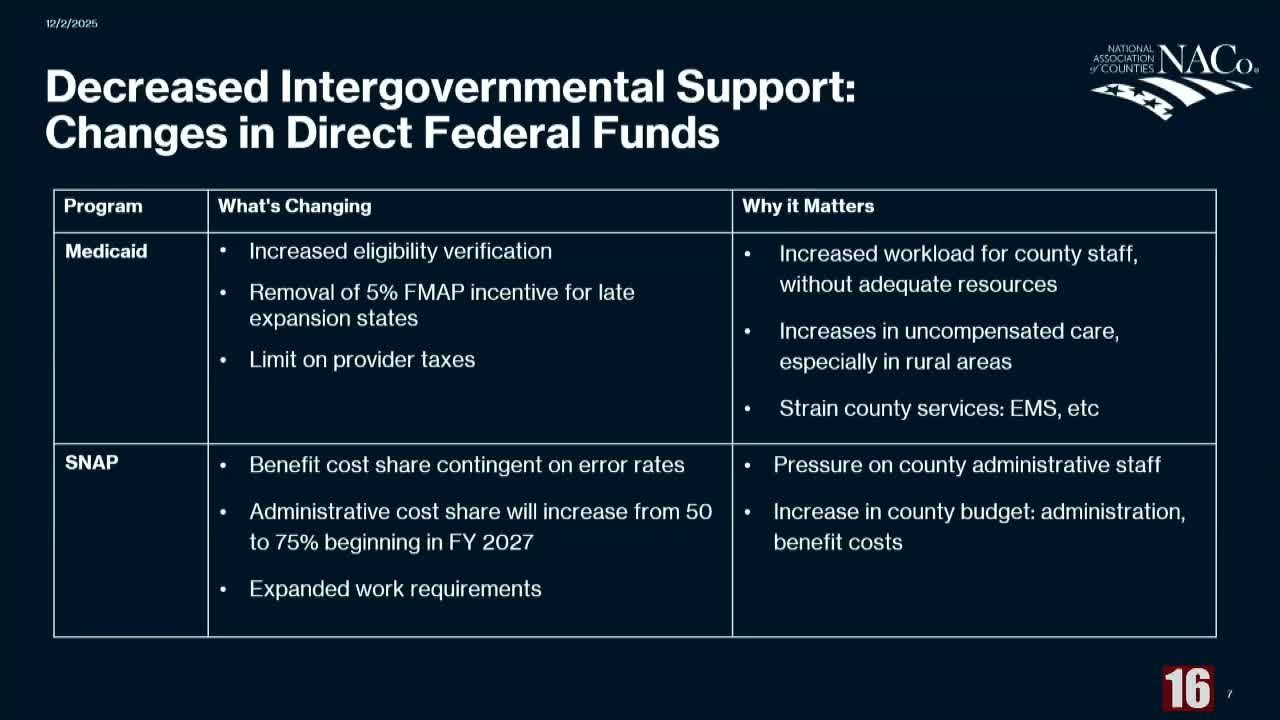
Presenters from NACo and the Ferguson Group told Fairfax supervisors that HR 1 and related federal actions risk shifting administrative and benefit costs for SNAP and Medicaid to counties; presenters cited a $19 million annual administrative cost and a possible $263 million increase in benefit costs for Virginia at current error rates.
Presenters from the National Association of Counties and the Ferguson Group told the Fairfax County Board of Supervisors Legislative Committee on Dec. 2 that recent federal policy changes, including provisions in HR 1, threaten to shift substantial costs and administrative burdens for SNAP and Medicaid onto local governments.
Mark Rotaco, chief government affairs officer at the National Association of Counties, summarized what NACo calls a “big shift” in federalism: reduced federal support, higher costs for counties and decreasing local autonomy. He said HR 1 changes the federal match for SNAP administration and estimated an additional $19,000,000 in annual administrative costs to Virginia counties under those changes. “The federal match that has existed for years is going from 50% federal, 50% local to 75% local, 25% federal,” Rotaco said.
Rotaco also cited a potential increase in benefit costs driven by a new error‑rate allocation mechanism, saying that “at Virginia's current error rate, that could mean an additional $263,000,000 to provide benefits for the SNAP program.” He added that those provisions will phase in on a rolling basis and that NACo is advocating for delays to ease the transition.
On Medicaid, Rotaco noted over 2,000,000 Virginians are enrolled and that Fairfax County alone has “over 150,000 residents” on Medicaid, making the program the county’s largest administratively. He also referred to a CBO projection (as discussed in the presentation) that roughly 11,800,000 people nationwide could become uninsured as a result of HR 1’s changes.
The panel flagged how those programmatic shifts intersect with local budgeting: counties can consider cutting discretionary projects, dipping into reserves, raising limited local taxes or fees, or finding operational efficiencies — but each option carries trade‑offs. Rotaco said counties are coordinating advocacy, and he urged engagement at milestone moments such as the farm bill, appropriations negotiations and other congressional opportunities.
Board members stressed the local consequences. Chairman McKay and other supervisors raised concerns about the cumulative effect of federal cuts on Fairfax’s fiscal forecast and residents’ access to food and health care. Mark Rotaco said organized county and state advocacy would be necessary to delay or soften implementation.
Next steps: staff and outside advocates will continue to press the county’s General Assembly and congressional delegation on delays, clarifications and funding protections. The Board will consider the county’s formal federal legislative program at its Dec. 9 meeting.