Lifetime Citizen Portal Access — AI Briefings, Alerts & Unlimited Follows
Fairfax officials outline EV-readiness strategy but say full fleet electrification by 2035 is unrealistic
Loading...
Summary
County staff presented a community EV-readiness strategy and a fleet transition assessment that finds many mission-critical vehicles lack suitable electric alternatives; staff propose targeted charging expansion, public–private partnerships, and deferred replacements where appropriate.
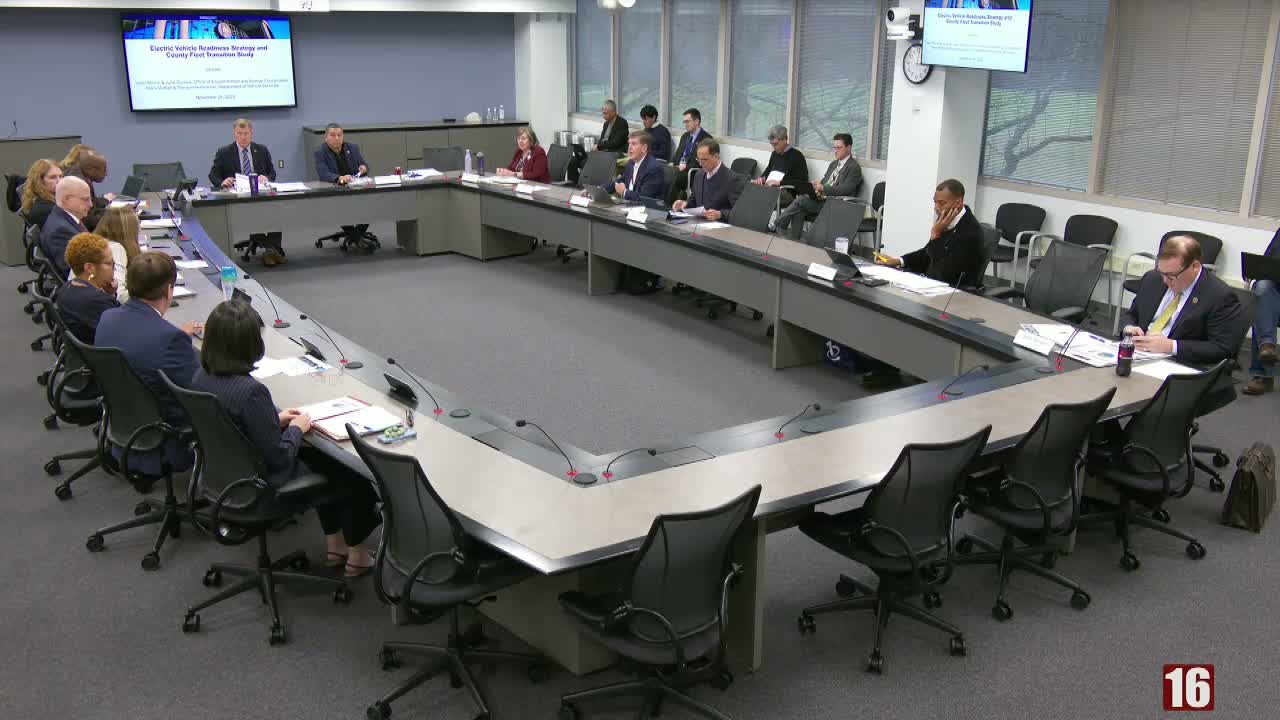
County staff on Nov. 25 presented a two-part electric-vehicle plan that combines a community charging strategy with a frank assessment of the county fleet's ability to convert to battery power.
"Electricification of the county, entire county fleet by 2035 ... is unattainable," John Morrill, director of the Office of Environmental and Energy Coordination, told the Environmental Committee. He cited limited commercial availability of suitable EV platforms for public safety, heavy vans and specialty equipment, and a slowed pace by vehicle manufacturers.
Julie Gurney of OEEC summarized the community component: the county posted a draft on the Fairfax County Public Input site, held a town hall, and used GIS analysis to identify priority zones for Level 2 charging near residences and community centers and DC fast charging along major corridors. Preliminary 2024 vehicle registration data show more than 37,000 EV registrations countywide, and the community strategy aims to support the County’s CCAP target of 15% light-duty EV registrations by 2035 through siting, equity-focused placement, and partnerships with charging providers and CFI grant-funded projects.
Mark Moffett, director of the Department of Vehicle Services, outlined operational constraints. DVS maintains roughly 6,200 pieces of equipment (about 3,700 county vehicles and 2,500 school vehicles). "To date, we have 18 locations and 161 ports," Moffett said, and staff have designs for about 213 additional ports across 26 facilities plus a separate category of roughly 50 fleet-only ports at five sites. He said 76 battery-electric vehicles and about 40 hybrid electric vehicles are currently in the fleet.
Moffett and staff emphasized that many fleet roles — notably pursuit and other public-safety duties, heavy equipment and large vans — lack commercially available EV alternatives that meet operational needs. He summarized a consultant finding that, at the time of the study, roughly half of fleet vehicle types were candidates for "in-lieu" electrification but many mission-critical vehicles were not. "If they're not even putting forth the effort to try to build a vehicle, I can't, on your behalf, buy a vehicle to then test it and make sure it works for the community," Moffett said.
Supervisors pressed staff for practical next steps: district-level maps showing existing public charging and planned CFI grant sites, more granular cost and installation estimates, and clarity on vendor contracts and revenue. Marguerite Guarino of DVS said ChargePoint keeps a portion of revenue under existing arrangements and the county's share is deposited into a fund used to purchase additional stations. Staff said public-facing chargers can accept private payment while county vehicles use charge cards that bill departments.
Board members also raised the idea of issuing RFPs to allow private operators to install chargers on county land at no cost, subject to maintenance and service requirements, and asked whether staff can defer some vehicle purchases until more suitable EV models are available. Moffett said DVS already factors total cost of ownership and department needs into procurement cycles and can extend vehicle service life when appropriate.
The presentation concluded with staff saying they are meeting infrastructure providers, coordinating with DVS on CFI grant implementation, and will provide more detailed, district-level maps and any follow-up cost estimates to supervisors.
Next steps: staff will continue vendor engagement, finalize locations for CFI-funded chargers, and share GIS-based maps by supervisor district; the committee did not take action or vote on policy changes at the meeting.