Get AI Briefings, Transcripts & Alerts on Local & National Government Meetings — Forever.
Lewiston planning board and Complete Streets Committee discuss gaps in how projects get reviewed
Loading...
Summary
At a Jan. 12 workshop, Complete Streets Committee members and city staff said the traffic movement permit (TMP) is currently the main formal trigger for committee review; board members pressed to broaden engagement so pedestrian connectivity is considered for projects that do not meet TMP thresholds.
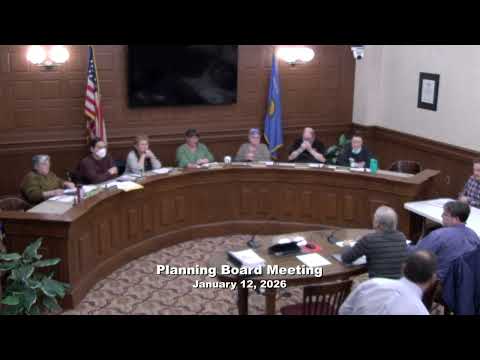
The Lewiston Planning Board met with members of the regional Complete Streets Committee on Jan. 12 to clarify how the committee is engaged on development and public-works projects and to identify gaps in the current referral process.
Paul Neehoff, a project engineer in public works who staffs the Complete Streets Committee, explained that the committee typically reviews projects that come with a traffic movement permit (TMP) or similar traffic-review trigger and that staff now invites Complete Streets to the scoping meetings that define a TMP’s study area. Committee members and advisors, including Jeremiah Bartlett, who recently served as committee chair, and Brad Pino from the Androscoggin Transportation Resource Center (ATRC), said the ordinance that created the committee is now about eight years old and contains compromises that leave some pedestrian- and bicycling-focused projects outside the TMP threshold.
"The ordinance is only gonna be so prescriptive about things," Bartlett said, urging attention to how the committee functions in practice and suggesting the committee’s role has often been more reactive than proactive. Planning board members described recurring examples where two adjacent developments (for example, an LHA housing project and a separate commercial proposal near Lisbon Street and East Avenue) share pedestrian connectivity issues but only one project triggered a TMP, leaving the other without coordinated review.
Staff described the typical sequence: an engineer submits a preliminary TMP application, staff identifies parties to invite (DOT, police, public works, Complete Streets and the applicant), a scoping meeting defines the study area, and later-stage mitigation recommendations are circulated for comment. Both sides said the committee has occasionally reviewed projects that do not strictly meet TMP thresholds when pedestrian improvements were anticipated, but they agreed the process is inconsistent.
Committee members said they want more plan-level work—setting priorities that would help them be strategic rather than only reviewing projects piecemeal. Staff and board members agreed to pursue more regular exchanges (for example, an annual priorities discussion) to align the committee’s work with planning board priorities without immediately changing the ordinance. Staff also committed to provide the committee and board with the underlying ordinance text and the Complete Streets policy memo referenced in the meeting.
The workshop closed with an agreement to continue communications and to consider modest procedural refinements so pedestrian and bicycle access are considered earlier in the development review process.