Mesa council adopts 1,000-foot battery storage setback after divided public comment
Loading...
Summary
The Mesa City Council voted 6-1 to adopt an ordinance setting a 1,000-foot separation between certain battery energy storage systems and residences, amid competing testimony from safety experts and industry representatives who said the setback is either necessary or overly restrictive.
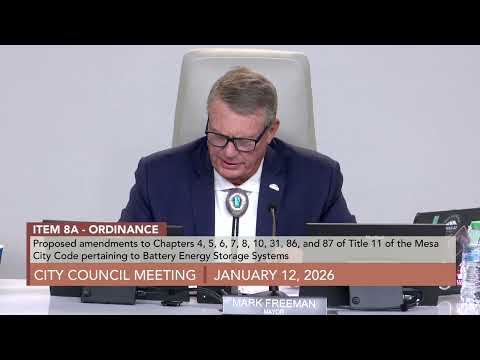
Mesa's City Council on Jan. 12 adopted an ordinance amending the Mesa City Code to set a 1,000-foot separation requirement between certain battery energy storage systems (BESS) and residences, passing the measure 6-1 after an extended public comment period.
The vote follows hours of testimony from engineers and fire-safety professionals who urged caution and from industry and technology groups who warned the setback was far outside national norms and could make projects economically infeasible. "Setbacks of this magnitude do not reflect the National Fire Protection Association standard," said Autumn Johnson, executive director of the Arizona Solar Energy Industries Association. "Measured examples typically fall between 50 and 150 feet." (Autumn Johnson, Executive Director, Arizona Solar Energy Industries Association.)
Why it matters: the ordinance establishes a siting rule that will change where large battery projects can be built in Mesa. Supporters argued the distance protects residents from rare but high-consequence battery incidents; opponents said the 1,000-foot threshold is arbitrary, will push projects away from needed electrical load and could raise costs for residents and businesses.
Public testimony showed the divide. Retired Honeywell engineer David Winstanley, who said he investigated high-energy battery incidents, urged the council to "keep the 1,000 feet and come back to it and revise it" once testing and code details are codified. (David Winstanley, retired director of engineering, Honeywell Aerospace.) By contrast, Sepand Elizada of the Arizona Technology Council warned, "By moving a 1,000-foot separation requirement forward, the city council may harm the viability of Mesa as a tech hub" and urged revisiting the setback. (Sepand Elizada, Arizona Technology Council.)
City staff and several council members said the ordinance responded to local safety concerns and will be revisited as technology, standards and testing evolve. The mayor noted that the Arizona Fire Marshals Association will adopt NFPA 855 soon and suggested the council could review the rule after technical guidance is available.
The council adopted the ordinance 6-1. Councilmember Duff announced she would vote no and asked for future reconsideration and additional study; the council majority said they expected to reexamine the standards as NFPA guidance and other technical data develop.
Next steps: the ordinance takes effect according to the city's normal code-adoption timeline; councilmembers and staff said they expect ongoing conversations with utilities and fire experts and signaled a willingness to revisit the setback within the coming year if warranted.