Dunedin planning agency recommends Main Street Exchange design review after lengthy presentation and public comment
Loading...
Summary
The Local Planning Agency voted to recommend approval of the Main Street Exchange design review, a 3–4 story mixed‑use project at 830 Douglas Avenue that includes an 89‑room boutique hotel, theater, food hall and off‑site parking garage; staff recommended approval subject to standard conditions.
The Local Planning Agency of the City of Dunedin voted on Jan. 14 to recommend approval of the design review for the Main Street Exchange, a mixed‑use redevelopment proposed for 830 Douglas Avenue that would replace a vacant three‑story office building with a 3‑ to 4‑story project including an 89‑room boutique hotel, marketplace, theater, food hall, restaurants and retail.
Staff and project representatives told the LPA the project meets the applicable land development code standards for the site’s Activity Center land‑use designation and Downtown Core zoning, subject to standard conditions such as a revocable parking agreement and consistent construction plans. George Kinney of the Community Development Department introduced the application and noted staff’s consistency finding with conditions.
“The Main Street Exchange will consist of a 3 and 4 story mixed‑use building comprised of 89 boutique hotel rooms, a marketplace, theater, food hall, restaurants, social establishments, retail spaces, and a parking garage,” George Kinney said during the staff presentation. The applicant highlighted design work intended to maintain pedestrian scale, including stepped facades and public plazas.
Bob Ironsmith, the city’s downtown development director, described the project as a downtown “signature” and argued it will generate foot traffic that supports local retail and restaurants. “This is a really, significant project for downtown,” Ironsmith said, pointing to recent public investments the city has made in downtown capital projects.
Technical testimony focused on parking, valet operations, and traffic impacts. The applicant plans on‑site structured parking (133 spaces) plus a separate 318‑space garage about 700 feet north; 125 spaces in that garage are proposed to be reserved for the project’s valet operation. Traffic engineer Jane Caldera said the PM peak hour estimate is about 230 inbound vehicles and 192 exiting, and that the highest additional peak‑hour volumes would be on Douglas rather than Main Street.
“Our estimates are about 230 vehicles coming in to the project in the PM peak hour and 192 exiting,” Caldera said, and she explained the analysis included valet trips and conservative peak‑season adjustments.
Public comment included both supporters and skeptics. Longtime hospitality operator Peter Kreutiger urged the board to support the plan, saying it would add family‑friendly cultural space and economic vitality. Several residents warned the project could change the downtown’s coastal character and asked for careful attention to scale and parking fees.
Applicant representatives said mechanical equipment will be roof‑mounted and screened and that the proposed multipurpose theater/event space is intended to be usable by community groups as well as private events. The applicant also emphasized that the developer controls the off‑site garage parcel and that coordinated construction schedules aim to limit temporary parking displacement.
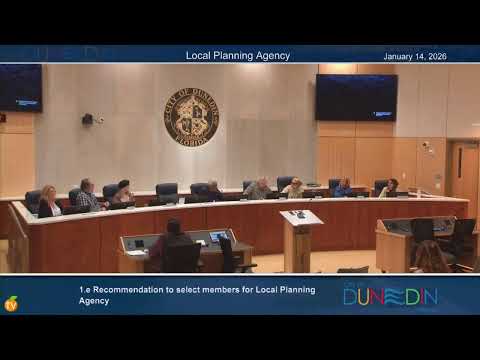
A board member moved to approve the design review with several suggestions — including softening some colors in the conceptual elevations and consulting with the Dunedin Public Theater Foundation on programming — and a second followed. After final comments from board members praising the sidewalks and additional parking capacity, the chair called a voice vote; the chair announced “the ayes have it.”
The LPA’s favorable recommendation (voice vote) sends the design review forward for final action by the City Commission, where any requested waivers and conditions will be considered. The record shows staff recommended approval subject to the stated standard conditions and the applicant will next appear before the commission for final approval and any required code waivers.
The LPA record for the project includes the staff report, architectural review committee minutes, parking agreement language, and the traffic and stormwater studies submitted with the application. The City Commission will schedule the matter for a subsequent hearing and decision.