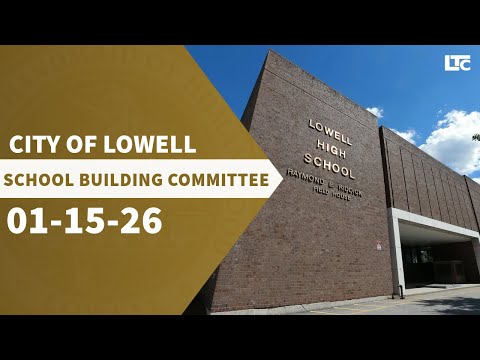
Lowell High School team asks City Council for $36.2 million to finish Phase 4
Loading...
Summary
Project team told the School Building Committee that a loan order requesting about $36.2 million has been submitted to City Council to fund an additional year of work on Phase 4, covering extended general conditions, consultant extensions, subcontractor time extensions and contingency.
Project managers for the Lowell High School reconstruction told the School Building Committee on Jan. 15 that they have submitted a loan order recommendation to the City Council seeking approximately $36.2 million to extend and complete Phase 4 of the project.
Kevin Kane of Skanska, speaking for the construction team, said the city is budgeting against a $381 million total project cost. He described the $36.2 million request as a package that includes roughly $11.9 million for extended general conditions and project overhead, about $2 million each to extend the contracts with construction manager Skanska and designer Perkins Eastman, roughly $6 million for subcontractor time-and-escalation funding, and a contingency range the team put at several million dollars to cover unknowns encountered during renovation of older structures.
The request has emerged after Phase 3 (the 1922 building footprint, Building A) was turned over to the school in early January and the team commenced Phase 4 work in mid-January. Justin Lyons of Suffolk said Phase 4 is scheduled to run from January 2026 through June 2027, with substantial completion targeted for June 2027 and two to three months of residual site and landscape work afterward.
Committee members pressed staff for detail about what is included in the committee’s budget summaries. Kane explained that the Massachusetts School Building Authority (MSBA) treats some change orders differently — MSBA historically does not roll pending change orders into the official total until closeout — which can make encumbrance lines and the ‘total project budget’ appear inconsistent in quarterly reports. Kane said the team will continue to provide the MSBA quarterly log and additional contingency and change-order detail to committee members on request.
Members asked whether items listed as $9 million in pending change orders include all contractor and consultant requests; Kane said that the $9 million line contains a mix of known pending items and selected entries, and that roughly $1–1.5 million in that figure is tied to basement rework. He added that the larger $36 million package represents an aggregation of items not yet fully encumbered in the same report.
Several members said they are concerned about the pattern of incremental requests for additional funds. Committee member James Hall asked when the project team could give the committee confidence that the $36.2 million would be sufficient, and Kane and Lyons said the team is analyzing risks found during demolition and will present identified solutions and cost proposals as they are developed rather than speculative worst-case lists.
The committee was also assured that the $2.1 million previously transferred from the FF&E (furniture, fixtures and equipment) line into contingency earlier in the project is still within the overall project budget and staff expect it to be restored to FF&E as that line is finalized.
Next steps: the loan order recommendation has been transmitted to the City Council for its consideration; committee staff said they will continue to provide the councilors and the SBC with updated change-order logs, contingency utilization reports and the MSBA quarterly report.