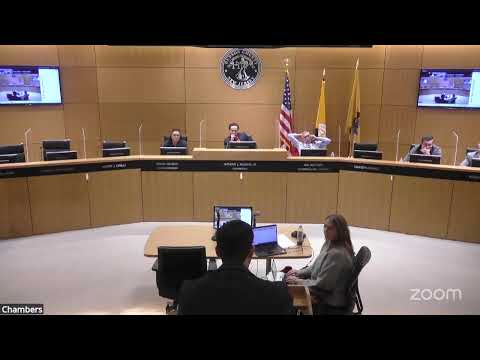
Residents press Hudson County commissioners on ICE activity and license‑plate data sharing
Loading...
Summary
Residents and local activists urged the Hudson County Board of County Commissioners to adopt clearer policies and stronger notification practices after repeated reports of ICE encounters on county property; a privacy expert urged the county to review any contracts with Flock Safety or similar license‑plate‑reader vendors.
Hudson County residents and community advocates used the board’s public comment period to press commissioners for clearer action after repeated sightings of U.S. Immigration and Customs Enforcement agents on county property and concerns that commercial license‑plate camera networks could be used to locate people.
Jenny Davis, manager for the county executive, read a statement from the county executive reaffirming the county’s adherence to state guidance: "The New Jersey Attorney General guidelines outlined in the Immigrant Trust Directive Act ... prohibit local law enforcement from cooperating with federal immigration authorities. As county executive, he ... has a standing agreement with the Hudson County Sheriff's Office to alert this administration and the board of commissioners if federal immigration authorities are conducting operations in our county parks and facilities." The statement said county officials "must and will work together to ensure the safety of Hudson County residents."
Speakers at the meeting said the county’s current practice leaves gaps. Courtney Walker, who said she has repeatedly raised ICE activity in Hudson County, said documentation has been inconsistent and demanded a firm county response: "ICE is not welcome here. We need clear action plans from the county when ICE shows up to county parks, to buildings." Walker also alleged a recent death in detention and said families need support when breadwinners are taken into custody.
Technology and privacy concerns were raised by Mark Bloomberg, who warned the commissioners that license‑plate readers operated by companies such as Flock Safety can reveal driving patterns across a camera network and be leveraged by outside agencies. "Flock cameras are very effective at reading license plates ... Simply running someone's plate through the system will tell you everywhere that vehicle has traveled within the flock network," he said, and asked the board to check whether any county departments have contracts with Flock or similar vendors and to review data‑sharing provisions.
Commissioners and staff took the concerns under advisement and asked for follow‑up. A staff member committed to researching whether county agencies have contracts with Flock Safety or comparable systems and to report back at the next caucus; a commissioner said the information should be provided formally and publicly. One commissioner urged that the county ensure deputies receive and review the Attorney General guidance routinely so that front‑line officers understand the county’s protocols.
The public commenters urged the board to consider a menu of local policy options adopted in other jurisdictions — from limits on staging or processing on county property to clearer family‑support mechanisms after detentions — and to provide a clear, public plan for responding when ICE operations occur on county facilities.
Next steps: commissioners asked staff to compile a report on any county contracts with license‑plate reader vendors and to bring findings to the next caucus; no formal county policy change was adopted at this meeting.