
Appropriations amendment to S.60 would create Farm and Forest Operations Security Fund but tie implementation to future appropriations
Get AI-powered insights, summaries, and transcripts
Subscribe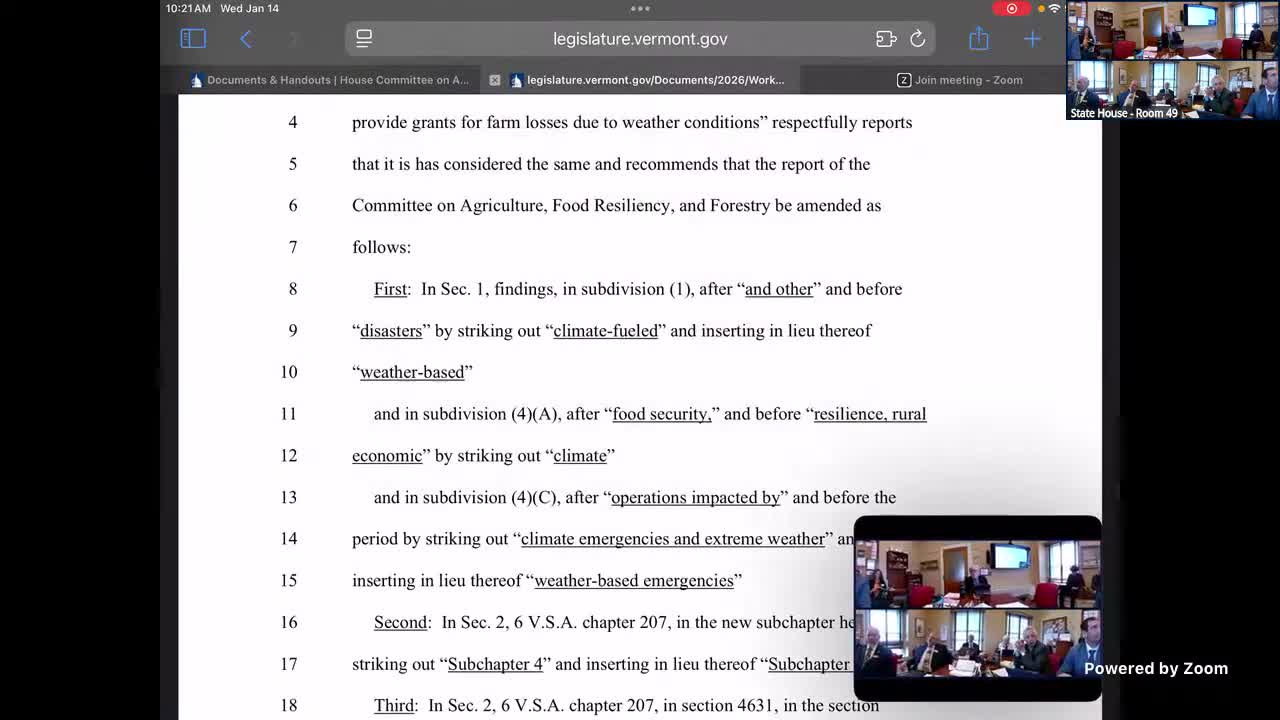
Summary
House Appropriations staff explained amendments to S.60 that remove "climate" language, rename and renumber statutory sections, require applicants to list recent state grants, and make the program implementable only if the Legislature appropriates funds in a later fiscal year.
Michael Grady, counsel with the Office of Legislative Council, briefed the committee on the House Appropriations Committee amendment to Senate bill S.60, which would establish a Farm and Forest Operations Security Special Fund to provide payments for farm and forestry operation losses due to weather conditions. Grady said the amendment contains five types of edits: technical renumbering, removal of references to climate, incorporation of an information‑disclosure amendment, adjustments to administrative authority, and a contingency clause tied to appropriations.
Grady told the committee that references to "climate" or "climate‑fueled" in the bill were replaced with "weather‑based" (and in some places with the shorter term "resilience") to avoid creating floor controversy. He read the bill's definition of "eligible weather condition," which lists high winds, excessive moisture or intense precipitation or flooding, extreme heat, abnormal freeze, forest fire or wildfire event, hail, drought, and "any other severe weather or growing conditions impacting agriculture or forestry operations." Grady said the amendment also shifts the proposed program from its originally drafted subchapter into a new subchapter and revises internal cross‑references so the statute can be codified without conflict with prior enactments.
The amendment incorporates a Representative's change requiring the secretary's application form to list any state grants or loans received by an applicant in the past five years, including amount, source and purpose, a disclosure the representative said would help the board consider award amounts. Grady clarified that the reporting requirement as drafted covers state grants administered through state programs; some federal programs that are run through state programs could therefore appear on the list if the state administration required it.
On administrative spending, Grady said the draft gave the secretary authority to use up to $67,500 annually from the fund for administration but acknowledged Representative Stevens' concern that a fixed dollar figure could be misleading if the fund is small. He said the committee is considering language to allow the agency to pay reasonable administrative expenses rather than locking in a specific amount.
Crucially, Grady said the amendment contains a contingency clause making implementation of the fund contingent upon a general‑fund appropriation in fiscal year 2027 or a subsequent fiscal year. "It will be statute, but the secretary will have no authority or requirement to implement this program unless the appropriation is provided," he said, calling the clause an "on/off switch" controlled by appropriations.
Committee members asked whether the fund could serve as a vehicle for rapid federal disaster aid. Grady responded that if the program were not implemented by appropriation, the state could still move federal money through other programs or propose that the agency budget explicitly accept federal or philanthropic awards subject to appropriation or Joint Fiscal Committee approvals when out of session.
Grady also summarized editorial and clerical fixes — a known spelling error in the title has been corrected by the House clerk and the amendment will be posted on the Appropriations committee website — and noted the amendment's effective date language was updated (the amendment proposes 2026 as the effective year).
The committee did not take a vote in the briefing. The amendment will go back to the Senate; members observed there is opportunity for further changes at that stage.