Get Full Government Meeting Transcripts, Videos, & Alerts Forever!
Get email alerts on the Stormwater Bylaw topic
No spam. Unsubscribe anytime.
Lakeville conservation panel presses for limits, clarity on draft stormwater bylaw
Summary
At a Jan. 13 Lakeville Conservation Commission meeting, members urged narrowing a proposed stormwater management bylaw to municipally maintained systems, asked that one authority be designated for enforcement, and set a schedule to circulate comments before spring town meeting.
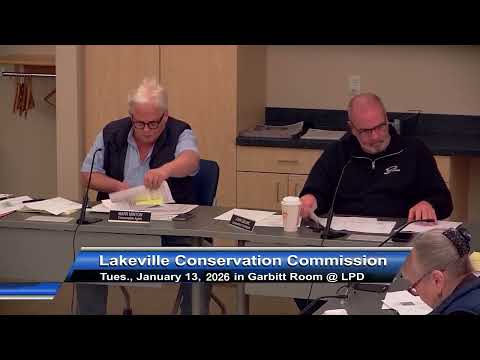
Members of the Lakeville Conservation Commission spent most of their Jan. 13 meeting debating how a proposed stormwater management bylaw should apply and who should oversee it.
The commission’s discussion, led during the regular meeting at the Lakeville Police Station, centered on whether the draft should impose townwide requirements or be limited to municipally maintained stormwater systems; whether the commission should be named a governing authority for the bylaw; and how to define technical terms such as “disturbance.”
“Part of our MS4 permit mandates that we do some kind of stormwater bylaw,” said Michelle Bouchard, a member of the Lakeville Conservation Commission, noting the town is already late to comply. Commissioners said they did not want to create redundant enforcement responsibilities. John LeBlanc, a commission member, said the panel should avoid becoming an enforcement body for systems the Department of Public Works already maintains.
Multiple members argued the bylaw ought to apply only where stormwater ties into public systems. “It seems like this bylaw would make the stormwater regulations apply to any property in Lakeville, whereas it should apply only to those who partake in this public stormwater system,” LeBlanc said. Commissioners repeatedly raised concerns about imposing requirements on private roads and homeowner associations whose drainage does not connect to public infrastructure.
Commissioners also discussed the draft’s governance structure. Some favored keeping oversight to a single town authority — whether the planning board or select board — and relying on DPW for maintenance and operational expertise. Members warned that having multiple bodies sign off could produce inconsistent plan-of-record versions across departments.
Technical questions dominated parts of the session: how to measure and cap the amount of disturbance that would trigger a stormwater review; whether simple activities such as raking and seeding should count as disturbance; and whether the draft’s map and version control were adequate. Mark Linton, the commission’s agent, said he would circulate a spreadsheet of examples from about 50 towns to inform the commission’s comments.
The commission agreed to assemble three items for review — the original bylaw, the marked-up draft, and the stormwater overlay map — and asked staff to circulate them to members. Members asked that a draft comment letter to the Planning Board be prepared and brought back for approval at the next commission meeting so the commission’s commentary can be finalized by March for spring town meeting consideration.
The review was procedural: no formal vote on the bylaw was taken, and commissioners framed their next step as drafting and approving comments for the Planning Board rather than adopting or enforcing policy.
The commission will revisit the draft at its next meeting, with members and staff expected to provide a compiled comment letter and reference materials.