Get Full Government Meeting Transcripts, Videos, & Alerts Forever!
Get email alerts on the Sign Code topic
No spam. Unsubscribe anytime.
Port Richey council tables extensive sign-code rewrite after hours of debate
Summary
After a multi-hour first-reading review that covered window signage, digital-display brightness, temporary and right-of-way signs, and political-sign timing, the Port Richey City Council voted to table Ordinance 26-740 for further edits and public input.
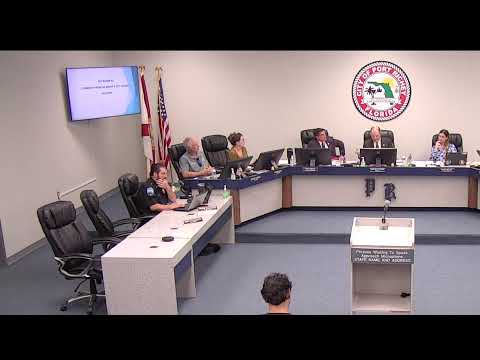
Port Richey — The City Council tabled a comprehensive rewrite of the city’s sign code on Jan. 13 after extensive discussion about how the ordinance would regulate temporary signs, digital displays and political advertising.
Mayor John Ayers Hoover opened the item, and City Attorney Nancy Meyer read Ordinance No. 26-740 by title, saying the draft reorganizes definitions, removes outdated provisions and aims to align the code with prevailing First Amendment case law. City Manager Don King and staff walked the council through multiple changes in the draft, including moving sections, renumbering and clarifying permitted and prohibited sign types.
Discussion focused on several specific points. Council members and staff debated allowing temporary signs in the city right-of-way so long as they sit at least five feet from the roadway, and whether written permission from the adjacent parcel owner should be required or merely 'permission.' King said the proposed language aims to allow some temporary signage with safeguards but flagged enforcement questions: who will monitor and how would the city distinguish permitted signs from others?
The council spent substantial time on digital and illuminated signs. Staff pointed to new language borrowed from neighboring jurisdictions that measures digital-display brightness in foot-candles and sets limits to reduce glare and driver distraction. As one councilmember summarized during the discussion: “This is saying not produce more than 1 foot candle of illumination 4 feet from the sign.” The draft also included limits on the rate of message change for digital displays and restrictions on special effects; council members debated whether dwell-time or outright restrictions were preferable and whether the standards were enforceable with the city’s current tools.
Members also wrestled with the treatment of interactive displays and QR codes near roadways, and with political-sign timing. The draft included a provision (based on suggested state guidance) changing how early political signs may be displayed; council opted to retain local qualifying-date language rather than adopt a 60-day pre-election rule.
After more than two hours of line-by-line review and several proposed edits, the council voted to table the first reading so staff and the city attorney can reconcile inconsistencies, add clearer enforcement language, and return with a version suitable for a formal first reading. Mayor Hoover put the motion and the tabled ordinance passed by voice vote.
The council directed staff to circulate a revised draft and to invite clarifying input from the police and code-enforcement staff about technical enforcement (for example, how foot-candle meters would be used and what permit documentation applicants must provide). The sign-code matter will return to a future meeting for a new first reading once those clarifications are integrated.
The decision leaves current sign rules in effect until the council adopts a new version.
Next step: staff will revise the ordinance to (a) reconcile numbering and cross-references, (b) clarify right-of-way temporary sign permission and enforcement, (c) confirm numeric lighting and digital-sign thresholds with a technical reviewer, and (d) return the ordinance for a new first reading.