Get Full Government Meeting Transcripts, Videos, & Alerts Forever!
Get email alerts on the Sustainability Policy topic
No spam. Unsubscribe anytime.
La Porte City staffer urges clearer local definition of 'sustainability,' highlights solar, composting and curbside reforms
Summary
City department guest speaker Nick Minnick told the La Porte City Sustainability Commission the community should define what sustainability means locally and proposed focused subcommittees, wider departmental engagement, and practical projects including wastewater solar, demand-based trash cans, and a pilot composting program.
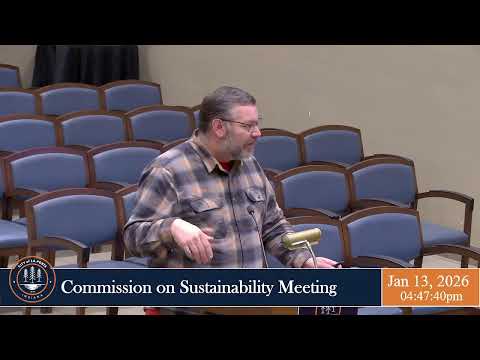
Nick Minnick, introduced as the city department guest speaker, told the La Porte City Sustainability Commission that defining ‘‘what sustainability means for La Porte’’ should be the commission’s first priority and urged practical, measurable projects the city can pursue now.
Minnick described his background in sustainable urban infrastructure and said communities often respond more to tangible energy and usage metrics than to abstract carbon measures. “The community defines what sustainability is,” he said, urging commissioners to identify locally meaningful goals rather than adopt a one-size-fits-all definition.
He highlighted several concrete opportunities the city has already pursued or could expand: on-site solar that has brought the wastewater treatment plant close to net-zero energy use; a federally funded propane-powered municipal fleet that fit local needs when other fuels were impractical; and an online permitting portal to reduce paper use and staff transcription. Minnick said these examples show the mix of small operational changes and larger infrastructure projects that together can move the city’s footprint.
On solid waste, Minnick noted the city’s trash contract is up for renewal and recommended evaluating a demand-based can system—where households pay less for smaller carts—as some nearby cities have done. He cautioned savings depend on local collection arrangements but said partnering with La Porte County solid waste could improve diversion and reduce landfill tonnage over time.
Commissioners pressed about composting and biogas. Minnick said the county currently offers composting services for yard waste but the city lacks an active food-waste collection program; he encouraged school-based pilots and public education. He also noted earlier economic modeling showed a compost-to-biogas build-out could have a much longer payback than rooftop solar (one participant referenced an estimate “over 40 years”), though Minnick pointed out a county-level waste-to-gas facility is in development and could change feasibility.
Minnick urged the commission to consider expanding membership so subgroups can pursue focused projects—green stormwater, energy, urban forestry—rather than asking a small body to handle every topic. He also raised tree-canopy concerns after the loss of a previous tree grant and recommended researching ordinances other communities use to require tree replacements or protections.
Commissioners and staff discussed limited city engineering and departmental staff capacity and explored using internship programs (for example, through Indiana University) and cross-training to increase capacity for sustained engagement. Minnick said department heads’ sustained involvement—rather than a one-time visit—would help move ideas into practice.
The commission agreed to review documents and pursue next steps, including a review of the ordinance governing commission membership and closer coordination with county solid waste to explore pilot diversion programs. The next meeting was set for Feb. 10.