Lifetime Citizen Portal Access — AI Briefings, Alerts & Unlimited Follows
Proposed rules would tie Workforce Pell eligibility to completion, placement and value‑added earnings limits
Loading...
Summary
Negotiators reviewed a draft that would make programs ineligible after governor withdrawal, failure of completion/placement metrics, or when published tuition exceeds a program's value‑added earnings; the department proposed specific timing rules (eligibility ending at defined payment period boundaries) and invited comment on liability and appeals.
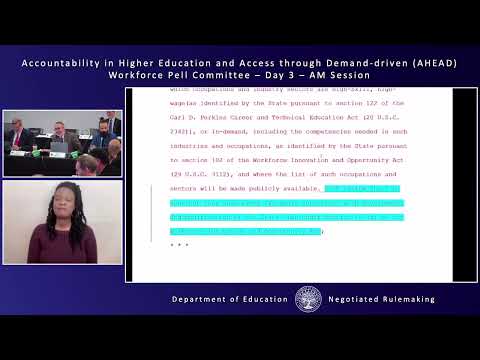
Department staff laid out the draft loss‑and‑regain eligibility provisions negotiators are debating under 34 CFR subpart H, explaining three separate triggers for losing Workforce Pell eligibility.
Under the department's proposal, a program would become ineligible at the end of the payment period that begins after the date: (1) a governor withdraws approval or fails to reapprove the program; (2) the Secretary determines the institution failed to meet Secretary‑level completion and placement requirements; or (3) the program's published tuition or fees exceed the program's value‑added earnings limit for the award year. For value‑added‑earnings‑based loss, the department explained it will publish the earnings once annually and that an institution that raises tuition above the published cap could face ineligibility for the subsequent award year.
Negotiators and legal staff repeatedly warned about the practical and legal implications. Several participants said the proposed 70/70 completion and placement threshold and the short timelines could exclude many programs or force institutions to design programs that do not rely on Workforce Pell. One negotiator also urged the department to ensure students who are already enrolled can finish their programs without being held financially responsible for institutional errors; department staff pointed to existing federal rules that bar holding students responsible for institutions' mistakes and said institutions would be the party primarily liable to return funds in overpayment cases.
Legal counsel and department staff cautioned that using non‑Title IV earnings or projected earnings as an eligibility gate would create substantial statutory and litigation risks; they asked proponents to submit revised text that squarely addresses those statutory limits. Negotiators raised the timing of value‑added earnings publication as an operational concern and the department indicated an initial expectation of roughly 90 days' lead time before the award year, but asked for alternative proposals on timing.
The department also proposed a multi‑part reinstatement pathway for programs that lose eligibility for tuition‑over‑VAE reasons: governor recertification, submission of current published tuition and a written attestation that tuition will not exceed the recalculated VAE, and a request for recalculation to apply to the next award year. For programs that fail completion/placement metrics, the department proposed a two‑year bar on reestablishing eligibility for substantially similar programs sharing the same four‑digit ZIP/CIP code to limit gaming.