Get Full Government Meeting Transcripts, Videos, & Alerts Forever!
Get email alerts on the Affordable Housing Policy topic
No spam. Unsubscribe anytime.
Council postpones vote on payment-in-lieu and impervious-surface incentives after debate on feasibility
Summary
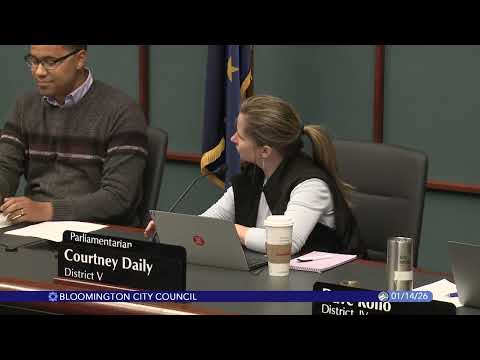
Council postponed Ordinance 2026-01 (affordable-housing incentives and payment-in-lieu changes) to Feb. 4 after debate about raising per-unit payment amounts, limiting payment-in-lieu eligibility, and concerns about stormwater and mortgage financing for deed-restricted owner-occupied units.
Council members voted 8-0 on Jan. 14 to postpone consideration of Ordinance 2026-01 to the Feb. 4 meeting after extended discussion and public comment over two central reforms: (1) a proposed administrative-manual increase in the payment-in-lieu amount (the department proposed raising the base from $30,000 to $50,000 per unit and using 30% of a project's units as the base for the calculation), and (2) a discretionary incentive that would allow a maximum impervious-surface allowance up to 80% for owner-occupied single-family and duplex lots in R1–R4 zoning when used to achieve affordability goals.
Assistant Director Jackie Scanlon described the policy intent: to discourage payment-in-lieu where on-site units are feasible while increasing the financial disincentive for opting out. "The dollar amount provided as a payment in lieu of providing housing must be based on the minimum percentage of eligible units as described in the administrative manual," she said when reading the proposed administrative text. The draft raised the unit-equivalency base to 30% of total dwelling units and proposed $50,000 per unit for 1-3 bedroom units, plus $5,000 for each bedroom beyond three.
Council members and stakeholders raised technical and practical concerns. Council member Rallo questioned how an 80% impervious-surface allowance would work with the city's stormwater requirements and whether detention and retention systems sized on maximum buildout would be adequate. Scanlon said detention is sized in subdivision situations to the maximum buildout assumed and that the incentive was expected mainly in subdivision contexts but acknowledged the need for scrutiny. Mayor Thompson and business and finance stakeholders said deed restrictions that require permanent affordability can make mortgage financing difficult; Thompson recommended exploring alternatives such as shared-equity agreements or soft-second mortgages to preserve owner-occupancy feasibility. "When you put a deed restriction on something that says permanent affordability ... the mortgage market ... we're not lending on it," the mayor said.
After public commenters including Christopher Emge of the Greater Bloomington Chamber of Commerce urged the council to consider developer feasibility and administrative collection costs, Council member Stossberg moved to postpone the ordinance to Feb. 4 to allow staff and attorneys to evaluate legal and implementation questions; the motion passed 8-0 by roll call.