Get Full Government Meeting Transcripts, Videos, & Alerts Forever!
Get email alerts on the Land Use Affordability topic
No spam. Unsubscribe anytime.
Council adopts amendments to UDO to tighten affordable-housing tiers and definitions
Summary
Council approved amendments to Title 20 (UDO) to set Tier 1 affordability at 90% AMI, Tier 2 at 70% AMI, change PUD qualifying standards to align with Tier 1 and remove an unused 'workforce housing' definition; Plan Commission recommended the petition with edits and council passed it 8-0.
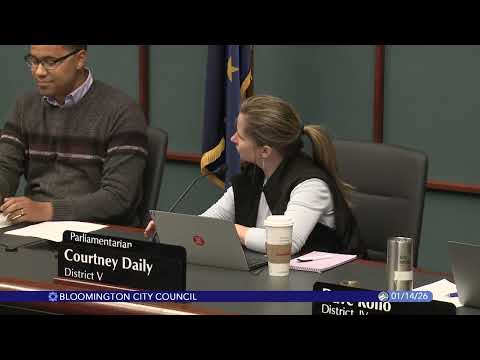
The Common Council voted 8-0 on Jan. 14 to adopt Ordinance 2026-02, which implements text changes to Title 20 of the Bloomington Unified Development Ordinance (UDO) to implement previously directed resolutions addressing affordable-housing incentives.
Assistant Director of Planning and Transportation Jackie Scanlon explained that the ordinance responds to Resolution 2025-17 and contains three primary changes: it sets area median income (AMI) thresholds for incentives using whole percentages (Tier 1 to include some units priced at or below 90% of AMI; Tier 2 to include units priced at or below 70% of AMI), it revises qualifying standards for planned unit developments so developments must include the Tier 1 percentage of permanently income-limited units, and it removes the unused code definition of "workforce housing." Scanlon said the Plan Commission heard the petition on Nov. 10, 2025 and forwarded it to the council with a positive recommendation after amending percentages to whole numbers.
Scanlon told council members the changes were intended to better reflect local conditions in Monroe County. "Tier 1 ... include at least some of the units priced below 90% of area median income," she said, and the amendments reference existing code sections so qualifying standards align with the new tiers.
Council members who authored or supported the original resolution thanked planning staff and the CAC for their work. With no substantive public comment, the council adopted the ordinance by roll call vote, 8-0. Staff said additional administrative changes would be made where necessary to implement the new text and that future work on related UDO sections could be brought back if legal or technical questions arise.