Get Full Government Meeting Transcripts, Videos, & Alerts Forever!
Get email alerts on the Public Transit Fares topic
No spam. Unsubscribe anytime.
Committee amends and reports out bill raising some Oahu transit fares, drawing Title VI concerns
Summary
The budget committee amended Bill 50‑420 to CD2 and reported it out for passage on third reading. DTS said modest fare increases would yield about $3.6 million; council members and advocates warned of disparate impacts on low‑income and minority riders per a Title VI analysis.
The Budget Committee on Jan. 13 advanced a revised Bill 50‑420 (CD2) that includes modest increases to some Oahu transit fares, while excluding raises for low‑income, senior, disabled and Medicare eligible riders. The Department of Transportation Services (DTS) estimated the changes would raise about $3.6 million on a roughly $45 million fare base.
Roger Morton, director of the Department of Transportation Services, told the panel the proposed CD2 includes a 25‑cent increase to cash bus fares (cash users only), raises the seven‑day pass from $35 to $45, and increases the handy‑van fare to $2.50 while preserving HoloCard single‑ride pricing. "The fares have not been increased for about four years," Morton said, and the proposal is intended to balance revenue needs with protections for low‑income and paratransit users.
Councilmember Dos Santos Tam, citing the administration’s Title VI analysis, told the committee the report found disparate impacts on poor and minority riders and urged caution. The councilmember quoted data from the analysis, saying a majority of riders have low household incomes and that raising fares would add roughly $110 per year for the average rider who pays cash. "This is really something that’s going to hurt families around this island," Dos Santos Tam said.
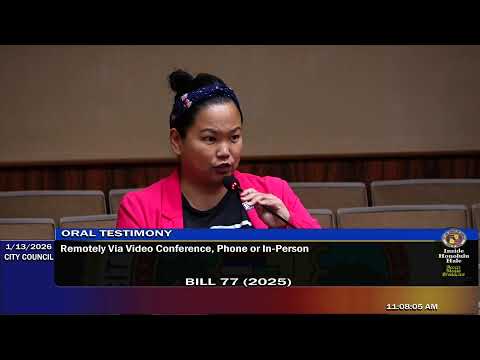
Community testifiers widely opposed the increase. Family of Bus Riders member Samantha Lara said raising fares would “directly burden families who already rely on the bus,” and Unite Here Local 5 speakers warned hotel and service workers rely on affordable transit for commuting. Donald Sakamoto, testifying as a transit advocate, supported the measured increases for certain fares and emphasized the need for wallet‑pay/HoloCard ease of access.
DTS told the committee that fare revenue is a small share of system costs (roughly 10%) and that the department expects significant budget pressures from collective bargaining and inflation. Morton said removing the proposed revenue would risk service reductions: "Losing $5,000,000 — which is approximate amount that this revenue would have — if we took that out of bus service, it would have a much greater impact than the increase in the fare level." The committee amended the bill to a CD2 and recommended it be reported out for passage on third reading.