Get Full Government Meeting Transcripts, Videos, & Alerts Forever!
Get email alerts on the Domestic Violence Hearing topic
No spam. Unsubscribe anytime.
Philadelphia council holds hearing on domestic violence after recent fatality; officials pledge data and enforcement fixes
Summary
Philadelphia City Council convened a public safety hearing after the murder of a young woman to examine gaps in policing, prosecution, PFA enforcement and services for victims. Prosecutors, police, the sheriff and advocates outlined steps—including a lethality-review tool, weekly case reviews and proposals for a specialized DA unit—and identified the need for better data sharing and funding.
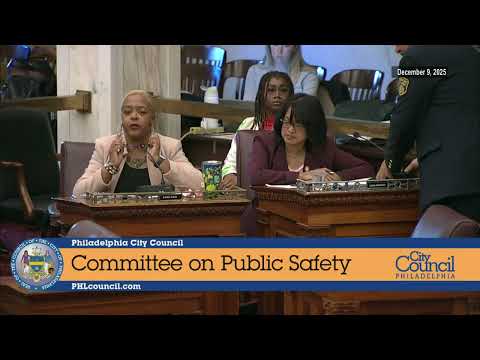
Philadelphia City Council's Public Safety Committee held an extended hearing focused on how the city protects victims of domestic and intimate-partner violence, following the recent killing of a young woman whose family attended the session.
Council President Kenyatta Johnson opened the hearing by asking city agencies, prosecutors and victims'service providers to identify where the criminal-justice system is failing survivors and to offer specific remedies. "This hearing is about how we get it right," he said, and he emphasized it was not an investigation of an open case.
District Attorney Larry Krasner told the committee his office has multiple dedicated units that handle domestic-violence matters and provided a 23-month snapshot of case outcomes. He said municipal and common-pleas dispositions show both convictions and a significant number of dismissals: "When I look at this 23-month period ... you're looking at about 575 guilties and about 272 dismissals," Krasner said, adding that many cases never reach the common-pleas level because witnesses do not appear or because evidence is insufficient under existing rules.
Krasner previewed three initiatives he plans to advance: a weekly domestic-violence law-enforcement review modeled on the city's shooting-review process, renewed advocacy for increased funding to victim-service organizations, and a budget request for a dedicated unit of specialized prosecutors to take serious domestic-violence cases from charging through trial (vertical prosecution). He described specialization as a key strategy to improve outcomes: "When you can take the really serious stuff and assign senior prosecutors from beginning to end, the chances of better results increase," Krasner said.
Philadelphia Police Commissioner Kevin Bethel described PPD's reorganization of victim assistance under a new Office of Community Advocacy & Engagement and announced plans for a standardized danger-assessment (lethality) tool to flag high-risk cases at the scene. Bethel said the tool will be piloted in early 2026 with plans for a full launch later in the year and that a weekly partnership case-review will elevate immediate interventions for flagged cases.
Sheriff Rochelle Bilal described operational reforms to enforce firearm relinquishments ordered by courts under Pennsylvania's Act 79. Bilal said the sheriff's domestic-violence task force has processed thousands of PFAs and executed hundreds of related warrants; she stressed the office is now proactively coordinating with police and courts on gun recovery and enforcement procedures.
Witnesses and advocates from organizations including Women Against Abuse, the Office of Victim Advocate, Lutheran Settlement House, Congreso and others urged a broad set of reforms. Common proposals included rapid, consistent enforcement of protection-from-abuse (PFA) orders; better notification and communication for victims about court dates and case status; funded, sustained support for front-line providers and shelter capacity; mandatory, trauma-informed training for judges and court staff; and improved, real-time data-sharing among police, prosecutors, the sheriff and providers.
Multiple speakers described gaps that can leave victims exposed during the days after arrest and before formal court orders are entered into law-enforcement databases. Several witnesses urged a city-supported plan for interoperable case-management or data-integration tools so warrants, PFAs and bail conditions are visible across agencies.
The committee closed the hearing by scheduling follow-up meetings and promising to convene a cross-agency working group to translate the hearing's recommendations into concrete actions, including technology upgrades, reviews of bail and stay-away practices, and funding priorities. The chair said the Council would seek ongoing accountability and report back to the committee on progress.