Get Full Government Meeting Transcripts, Videos, & Alerts Forever!
Get email alerts on the Governance And Ethics topic
No spam. Unsubscribe anytime.
Charlottesville housing authority gets refresher on FOIA, conflicts and agency powers
Summary
Legal counsel Delphine Karnes led a training for Charlottesville Redevelopment and Housing Authority commissioners on FOIA rules, conflicts-of-interest limits, HUD oversight and the narrow circumstances for closed sessions; the board certified a brief closed meeting and heard one public comment.
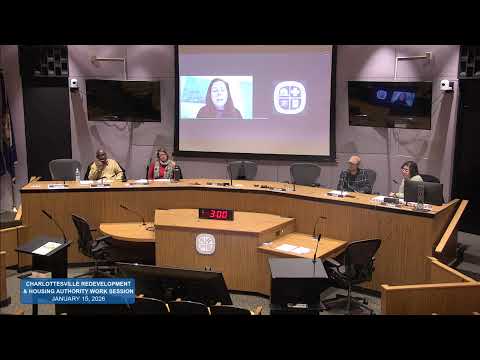
Legal counsel Delphine Karnes led a training for the Charlottesville Redevelopment and Housing Authority on the Virginia Freedom of Information Act, conflicts-of-interest rules and the statutory powers of public housing authorities.
Karnes told commissioners that housing authorities are "creatures of statute," explaining that CRHA has only the powers specifically granted by state law and that it was activated locally in 1954. She summarized the agency's core authorities — housing projects, redevelopment projects and conservation work — and said federal funding has largely limited the agency's options for conservation work.
Karnes reviewed limits on the exercise of eminent domain, citing the nationwide reaction to Kelo v. City of New London and subsequent Virginia statutory and constitutional changes that make it difficult for housing authorities to condemn non-blighted property. "As of today, I can tell you there is no eminent domain happening for housing authorities," she said.
The session focused heavily on FOIA. Karnes warned that a meeting about CRHA business occurs whenever three or more commissioners discuss authority matters "in person, by text or by email," and that such meetings must be publicly noticed and open to the public. "If you have three commissioners together discussing CRHA business, whether it's at a cocktail party, a wedding, or through an email that involves three commissioners, or through a text message, that's a public meeting," she said. She also outlined two exceptions allowing electronic meetings: a state-declared emergency and a pre-adopted remote participation policy.
Karnes described public-records obligations and FOIA timing: when CRHA receives a FOIA request it must respond within five business days and may request an automatic seven-business-day extension. She noted common exemptions (personnel records, attorney-client privilege) and reminded commissioners that communications about agency business on private accounts or devices are still subject to disclosure if they pertain to CRHA business.
On conflicts of interest, Karnes advised commissioners to avoid contracts or financial relationships with CRHA for themselves or immediate family, and to decline gifts intended to influence official action. She cited a Virginia rule limiting gifts from a potential contracting party to less than $100 per year and described HUD's additional restriction: CRHA may not enter into contracts with present or former commissioners during their tenure and for one year after a commissioner leaves office. She said HUD may grant rare waivers after review by counsel and the field office.
Karnes underscored the board's three core duties — set broad policy, adopt and oversee the budget, and hire and evaluate the executive director — and cautioned commissioners against intervening in day-to-day operations or personnel matters below the executive director level.
Votes at a glance: - Motion to convene a brief closed session pursuant to the Virginia Freedom of Information Act: motion seconded and approved (voice vote; exact tally not specified in the transcript). - Certification that the closed meeting complied with Virginia law: motion made and seconded and the board certified the closed session (voice vote; exact tally not specified in the transcript).
Karnes invited follow-up questions and additional trainings on topics such as low-income housing tax credits and financing structures. The training concluded and the meeting moved to public comment.