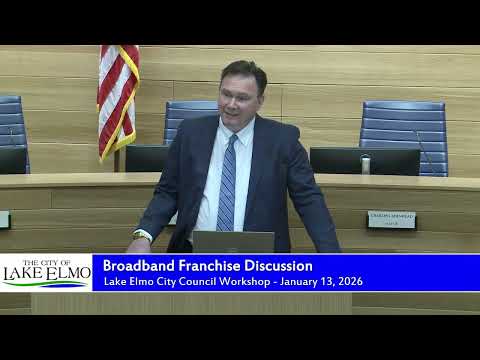
Lake Elmo hears case for municipal broadband franchising; experts urge due diligence
Loading...
Summary
An outside attorney described how Woodbury negotiated the state—irst broadband franchise and urged Lake Elmo to consider franchising to secure build‑out, customer service standards and franchise fees; commissioners asked for comparative data and legal risk analysis before directing staff to proceed.
Mike Bradley, an attorney who represents municipal cable and telecommunications commissions, told a joint Lake Elmo City Council and commissions workshop that franchising broadband can give cities tools to require full build‑out, set customer‑service standards and collect franchise fees.
Bradley said Woodbury negotiated the state—irst broadband franchise and that the model can include open‑access wholesale systems or vertically integrated providers. "We negotiated the state's first franchise," he said, adding that franchises can require a five‑year build‑out and allow cities to require fiber to government buildings and stronger customer service.
Why it matters: Commissioners said many Lake Elmo addresses currently have only legacy copper or limited DSL service, and they want to avoid neighborhoods where service stops at one side of the street. Bradley urged the council to give city management guidance to pursue conversations with the local telecommunications commission and pursue further due diligence.
Questions and concerns from councilors focused on legal risk, cost impacts and competitive effects. Bradley acknowledged uncertainty: recent 2025 court rulings (transcript references a case described as "Loper Breit") have influenced how courts treat broadband classification, and state law definitions determine whether cities can franchise broadband as a "cable communication system." He said a typical franchise fee in the Woodbury area was set at 5% to mirror cable practice, but he also noted that there is no federal cap for broadband franchise fees in the transcript discussion.
Several commissioners pressed for comparative outcomes from other communities: did new providers lower prices or improve service where franchises were used? Bradley said experience suggests competition often improves speeds and service while prompting incumbents to upgrade, but members asked staff to quantify consumer impacts before advancing a formal position.
No formal vote or ordinance was taken. Council direction recorded in the discussion: gather additional data on outcomes in other cities, clarify legal exposure and return with recommendations and cost comparisons to better inform any decision to ask city management to pursue franchise negotiations.
Provenance: Topic introduced SEG 001; discussion and Q&A continued through SEG 1033.