Jefferson County approves licensing and new safety rules for short‑term rentals
Loading...
Summary
The Jefferson County Board of County Commissioners voted unanimously Dec. 16 to adopt an ordinance and zoning regulation amendments that create a licensing system for short‑term rentals in unincorporated areas, impose safety and access standards, and use third‑party monitoring to boost enforcement. The rules set insurance, occupancy and response-time requirements and start accepting applications Feb. 2, 2026.
The Jefferson County Board of County Commissioners on Dec. 16 adopted an ordinance and updated zoning regulations to license and regulate short‑term rentals (STRs) in unincorporated Jefferson County, aiming to improve enforcement and safety particularly in mountain communities.
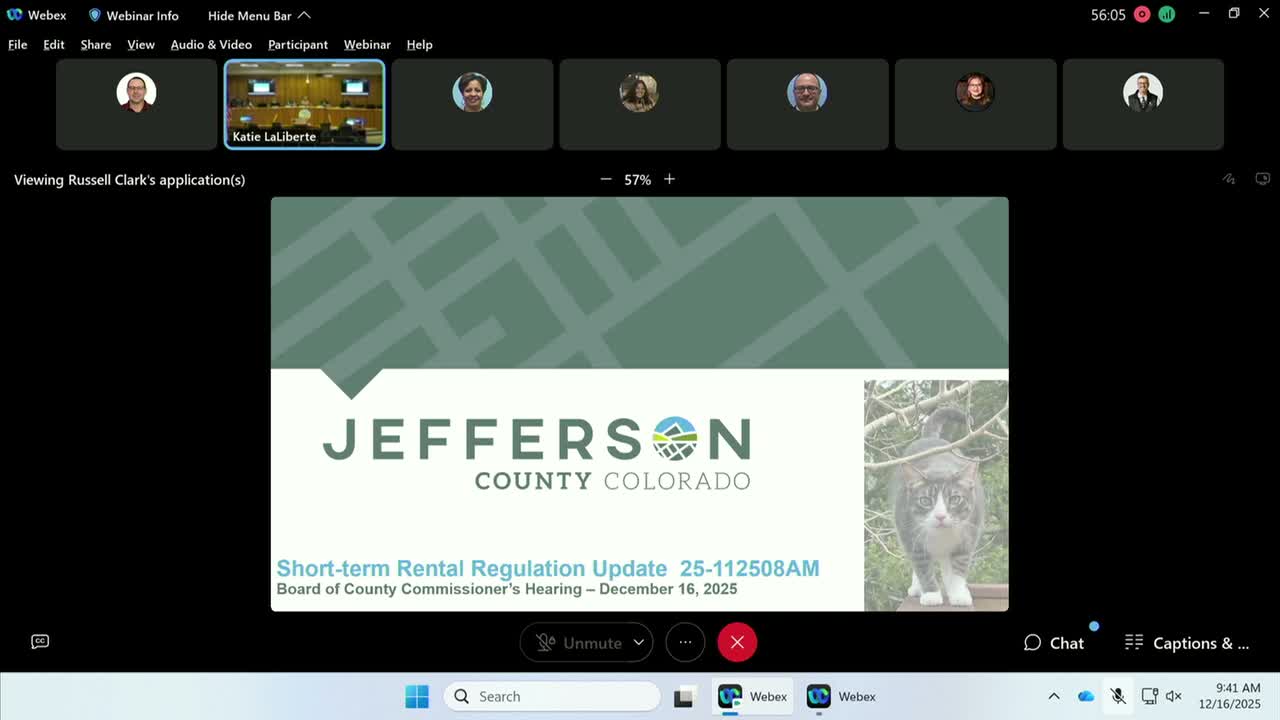
Planning and zoning case manager Russell Clark told the board the two‑part package — an ordinance that authorizes licensing and enforcement tools plus detailed regulatory changes — was developed after years of outreach and would be paired with a third‑party compliance vendor. "This is a brand new ordinance," Clark said, adding that the measure "allows, is necessary to allow us to do some of these enforcement actions." Staff said the county has a contract with Granicus/Host Compliance to identify listings and operate a 24/7 complaint hotline.
Under the adopted rules, short‑term rental operators in unincorporated Jefferson County must meet a set of requirements that include: displaying a county license number in listings; maintaining at least $500,000 in liability insurance and signing an affidavit attesting to coverage; proving adequate parking and wastewater (OWTS) compliance; and designating a local representative who can respond within 30 minutes. The regulations establish two license categories — primary residence and investment property — allow annual septic inspections, set occupancy limits (two people per bedroom with a 10‑person cap unless limited by an OWTS), and place limited transferability restrictions on licenses.
Clark said the regulations reference updated access standards in the county Transportation Design and Construction Manual for properties that take access from private or non‑county roads; applicants relying on private roads must provide proof of access and a letter from the local fire protection district confirming that access is adequate. Clark said the county will evaluate existing permits at renewal under the newer standards. "When they come in for their renewal, it will be under these new regulations," he told commissioners.
Residents who spoke during an extended public testimony period urged the board to tighten protections for mountain neighborhoods. Charlotte Horton, who lives in Evergreen, described living near an STR she said was disruptive and asked the board to "notify neighbors as part of the application process" and to restrict STRs on private roads. Seth Williams and other Evergreen residents warned private roads can be hazardous in winter, pose insurance and fire‑safety concerns, and said they worry about increased maintenance costs if visitors drive on locally maintained roads.
Commissioners and staff acknowledged those concerns and directed staff to return with specific recommendations on earlier neighbor notification. Clark said staff can add language requiring county‑sent notices to adjacent properties at application time if the board wishes; he also told the board the county will not begin aggressive enforcement until property owners have had time to apply under the new rules. "We'll start accepting applications on February 2," Clark said; he added that enforcement outreach will come first and fines would be a later step.
The board voted unanimously to approve Ordinance 11.1 and the regulations (case 25‑112508AM), and gave planning and zoning authority to make non‑substantive formatting edits before final publication.
Votes at a glance: Ordinance 11.1 (Vacation Rental Services) — adopted unanimously. Regulations, case 25‑112508AM (zoning changes to implement STR licensing) — adopted unanimously. The board directed staff to develop an earlier neighbor‑notification approach and to return with details.
The rules take effect for application intake on Feb. 2, 2026; staff said it will take months to process the roughly 600+ listings the county's monitoring vendor had identified and that enforcement actions will follow an outreach period.