Get Full Government Meeting Transcripts, Videos, & Alerts Forever!
Get email alerts on the Transit topic
No spam. Unsubscribe anytime.
YCIPTA updates board on ridership, costs and dependence on county dues
Summary
YCIPTA Executive Director Shelly Kreger briefed the Yuma County Board of Supervisors on transit operations, reporting 409,471 passenger trips last fiscal year, county dues of $3,311,684 and $12 million in prior unused grant matches returned to the state; board members pressed staff on fares, local vendor participation and options for a municipal or county tax to stabilize funding.
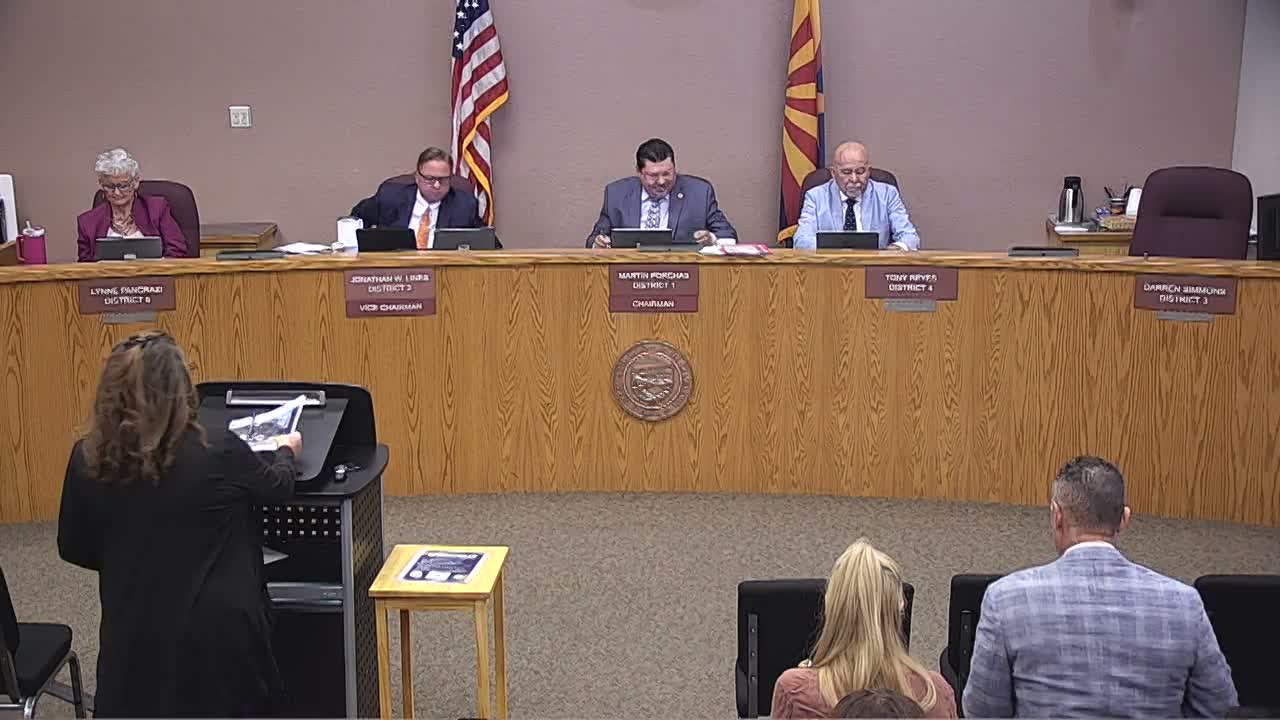
Shelly Kreger, executive director of YCIPTA, told the Yuma County Board of Supervisors that the agency’s mission is to “make essential connections possible” and outlined service, ridership and financial figures for the year.
Kreger said YCIPTA/YCAT provided 409,471 passenger trips last fiscal year and reported 35,284 revenue service hours. The system operates eight fixed and flex routes, paratransit demand‑response service and several vanpools. She identified the “yellow” route as the busiest, saying that route alone provided 241,822 riders for the fiscal year.
On funding, Kreger said Yuma County’s annual member contribution to YCIPTA is $3,311,684 and noted the board approved a modest 3% increase in member dues for the current year. She emphasized that fare revenue is small relative to operating costs—fares bring in roughly $450,000 annually, “only about 7% of what pays for our entire service”—and that YCIPTA returned approximately $12,000,000 in previous years because local match requirements were not met for available federal and state apportionments.
Kreger described the largest ongoing cost as the contract operator expense and said the fully allocated operating cost per service hour is about $178.02. She told the board YCIPTA pursues advertising, grant matches and in‑kind contributions to offset costs; recent bus advertising helped increase nonfare revenue, and the agency is running a five‑week food drive with advertiser donations.
Board members asked about fares and discounts; Kreger confirmed single rides cost $2, a full‑day pass costs $5, and discount fares are $2.50 for eligible riders. Members also questioned board composition and whether member entities are up to date on dues; Kreger said the YCIPTA board includes representatives of member cities, towns and the two Indian tribes and reiterated the need for stable local match funding.
Several supervisors and Kreger discussed structural options to stabilize funding, including a countywide sales tax (quarter‑cent or half‑cent), which Kreger estimated could generate roughly $5 million a year and reduce dependence on member contributions.
The presentation closed with a request that residents and member entities advocate for OCIPTA’s services and highlighted the agency’s upcoming 20th anniversary of providing transit in the community.
The board did not take a formal vote on policy or funding at the presentation; further action would require follow‑up agenda items or changes in local revenue policy.