Get Full Government Meeting Transcripts, Videos, & Alerts Forever!
Get email alerts on the School Safety topic
No spam. Unsubscribe anytime.
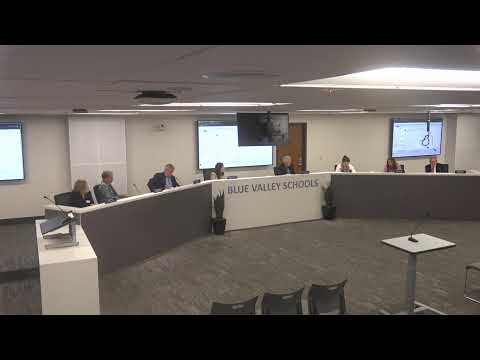
Blue Valley officials detail layered safety systems, say on-site officers remain difficult to staff
Summary
District staff reviewed layered safety strategies — threat assessment, crisis-alert beacons, door locks and tornado alerts — and debated the feasibility and budget implications of stationing sworn officers in every school; trustees asked staff to track pilot-year incident data.
Unidentified Speaker 3 (role: Unidentified) presented the Blue Valley School District's school-safety update, describing a layered approach that emphasizes building relationships, threat-assessment training and technology solutions to reduce risk.
The presenter said the district prioritizes culture and trusted adult relationships so students report concerning behavior, then uses data-driven threat-assessment protocols recommended by the Department of Homeland Security. He described recent facility and procedural changes: installation of thumb-turn locks with visual indicators so staff can verify doors are locked from across a room; a crisis-alert system that allows any staff member to trigger building lockdowns, flashing beacons and targeted responder notifications; and a new beacon color and announcement feature being configured to signal tornado warnings for building shelters.
"Safety is always our top priority," Unidentified Speaker 4 (role: Unidentified) said during the presentation, and Unidentified Speaker 3 added that the crisis-alert system has been a "game changer," used several hundred times a year to summon help and to communicate during emergencies.
Board members pressed staff on whether the district should place sworn officers in every building. Unidentified Speaker 3 said adding that capacity would require roughly 19 additional full-time officers and warned of practical challenges: recruiting officers willing to be assigned full-time to elementary schools and the difficulty local departments face in supplying large numbers of contracted officers. "Most people who become police officers do not want to sit in an elementary school all day," he said.
Trustees and staff discussed phased or hybrid approaches. Some members suggested increasing contracts with local police or gradually adding officers over multiple years; others encouraged investment in upstream prevention measures such as mental-health services and advocacy for state-level policy changes.
Several board members asked that staff collect systematic incident data during the pilot year rather than relying only on anecdotes. Unidentified Speaker 5 recommended weekly or per-incident reporting to ensure future policy choices are based on consistent metrics.
The presentation also recounted the district's use of evidence-based measures in recent years, including threat-assessment training for more than 200 employees, motion lighting and turf playground replacements after earlier safety incidents, and integration with local mental-health partners. The presenter said one immediate outcome is a focus on preventing external threats to elementary schools while maintaining full-time officer coverage at middle and high schools when feasible.
Next steps: staff will run the pilot implementation for the semester, formalize incident-tracking procedures and report findings at a future board meeting for follow-up action.