Get Full Government Meeting Transcripts, Videos, & Alerts Forever!
Get email alerts on the Community Development topic
No spam. Unsubscribe anytime.
Shoreline council adopts 2026 CDBG plan, directs most local funds to minor home repairs
Summary
City Council voted 4-1 to adopt a 2026 Community Development Block Grant spending plan that restores funding for the city—s Minor Home Repair program and commits a small local contribution toward an affordable housing acquisition project.
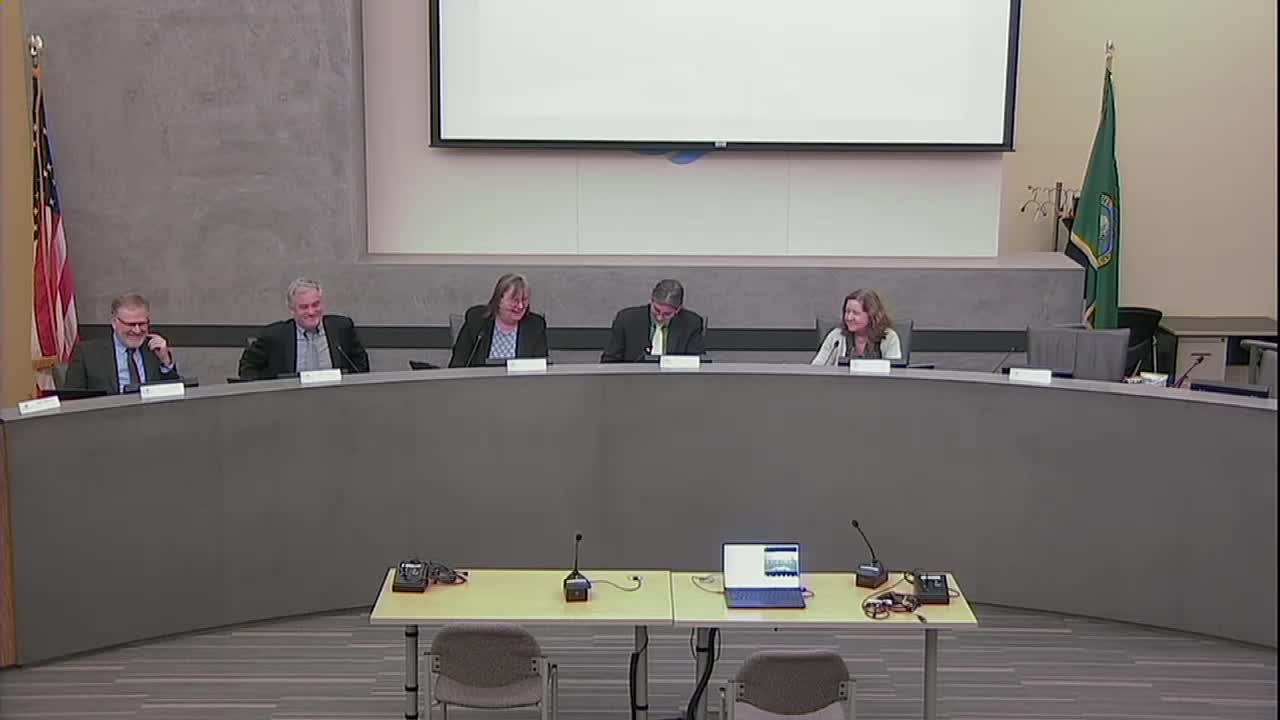
The Shoreline City Council on Oct. 27 adopted the city's 2026 Community Development Block Grant (CDBG) funding plan by a 4-1 vote, approving a package that restores the minor home repair program and allocates a modest local contribution to an affordable-housing acquisition project.
The approved plan directs the largest share of locally programmable CDBG funds to Minor Home Repair and sets aside $23,600 as a local contribution to an affordable housing acquisition project. Council members voted 4 to 1 in favor; Council Member Ramsdell voted no.
City staff told the council the city has an estimated $320,000 in CDBG entitlement for 2026 and $50,909 in unprogrammed CDBG funding from 2025. Federal and interlocal requirements reserve portions of that total: 25% for a major home repair loan program, 5% for housing stability (rent/mortgage assistance), 12% for King County administration, and 10% for Shoreline planning and administration. After those set-asides, staff said about $153,600 remains for local programming in 2026.
The staff recommendation adopted as "Option 1" would allocate $130,000 of the local remainder to the city's Minor Home Repair program and $23,600 to an affordable-housing acquisition project. Staff described the housing acquisition as a nonprofit-led purchase of roughly 110 units that would be deed-restricted at 60% area median income (AMI) for a minimum of 10 years; staff estimated the total purchase price of the buildings would be on the order of $20 million, making the city's contribution a relatively small local subsidy that enables the owner to access a tax exemption tied to state law.
The council—s discussion focused on trade-offs between repairing homes to keep residents safely housed and funding direct financial-assistance programs that prevent eviction. Several council members and staff emphasized that Minor Home Repair is currently the only consistent local funder for the kind of repairs that allow older homeowners to stay in place.
Emily Jones, director of the Shoreline Lake Forest Park Senior Activity Center, urged the council to restore funding for home repair in public comment before the vote. She described personal clients who could not afford basic repairs after the program was paused and said, "Please reconsider funding this program. I understand housing stability and utility needs, but what about homeowners losing hot water, having to wash up in the kitchen sink because the bathroom 1 doesn't drain, and no funds for repairs?" (public comment recorded Oct. 27.)
Council members pressed staff on the difference between the two funding options. Staff said Option 2 would reduce the Minor Home Repair allocation to approximately $120,000 and increase direct financial-assistance funding to the maximum allowed by the county-HUD interlocal rules, but that administrative and contract deadlines with King County limit how quickly reprogrammed 2025 funds can be redirected.
Council Member Ramsdell said she could not support Option 1 because of persistent unmet demand for rental and utility assistance. She cited Hopelink's reduced capacity in 2024 and 2025, saying the agency had moved from assisting roughly 14 to 15 households a month to four to five a month because funds ran out earlier in the year. Ramsdell said that reality made her favor the option that prioritized direct financial assistance over the larger Minor Home Repair allocation.
Other council members argued that CDBG program rules and timing make it difficult to increase immediate financial-assistance funding through CDBG, and that a mid-biennial (mid-budget) request from the city's general fund would be a more effective way to provide additional support to agencies such as Hopelink. Deputy Mayor Mark, who voted for the adopted plan, said he would support a mid-biennial request to boost direct-assistance funding outside the CDBG formula.
The motion approved by the council authorized the city manager to execute agreements with applicable agencies for the funded programs as listed in Attachment A of the staff report.
The vote: Deputy Mayor Mark, Council Member Scully, Council Member Aramasu and Mayor Roberts — Aye. Council Member Ramsdell — Nay. Motion passes 4-1.
Looking ahead, staff told the council Minor Home Repair will resume serving clients once the contracts are executed; staff also noted that the program served 43 households in 2024 and had served 49 households through July 2025 before suspending services while awaiting new funding. Council members emphasized continuing to explore additional funding sources and a possible mid-biennial request to expand rental and energy-assistance support.