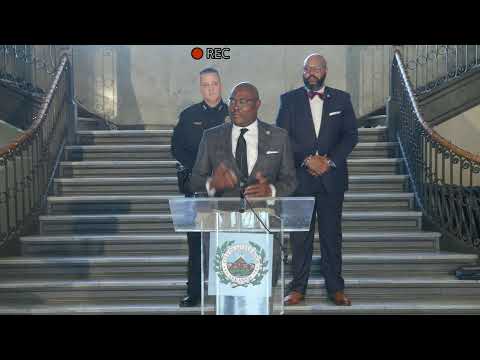
Little Rock officials report multi-year crime drop and say 2026 budget boosts police pay
Loading...
Summary
Mayor Scott and Chief Hilton delivered an end-of-year public safety update highlighting multi-year declines in crime (homicides down 47% over five years), the city’s recently passed 2026 budget that includes a 5% pay increase for police and fire, recruitment bonuses, and expanded technology funding.
Mayor Scott and Police Chief Hilton used an end-of-year public safety briefing in Little Rock to report multi-year declines in crime and to outline how the city’s new budget seeks to bolster public safety staffing and technology.
Mayor Scott said the city’s five‑year averages show a decline in crime: "overall crime has been reduced by 27%" and "violent crime has been reduced by 21%" over five years, and he added that year‑to‑date figures show "overall crime is down 21% and violent crime is down 12%." He emphasized what he called the most significant figure: "homicides are down over the past 5 years 47%." Mayor Scott attributed the improvements to what he described as a "holistic crime reduction approach" that pairs policing with prevention and treatment programs led by Michael Sanders, director of community programs.
The mayor also reported that the City passed its 2026 budget earlier in the week and described its priorities as economic development, quality of life and public safety. He said the budget includes a 5% pay increase for both police and fire personnel and incentives intended to reduce vacancies, including a $10,000 sign‑on bonus for new recruits and an additional $5,000 bonus for officers who move into the city from elsewhere. Mayor Scott said the budget also adds nearly $1,000,000 for technology and increases funding for code enforcement to address blight, which he called a contributor to crime. (The full 2026 budget total and line‑item breakdown were not specified in the remarks.)
Chief Hilton said the department has focused on returning to core policing practices and on interdepartmental collaboration with community programs, housing and parks staff. He described stepped‑up holiday patrols targeted at shopping centers and other high‑traffic locations and encouraged residents to "see something, say something." Chief Hilton highlighted recovery figures: "So so far in 2025, we recovered a 109 stolen vehicles," and said recovered property totals for those cases were about $1,900,000 this year versus about $1,100,000 the prior year.
The chief also described the Real Time Crime Center’s growing role in investigations, reporting roughly 2,700 registered residential cameras (home and doorbell devices) and about 2,500 business integrations linked with the center.
On staffing, Mayor Scott said the city currently "may have 50 to 60 vacancies" in the police department but that retirements and recruitment cause year‑to‑year fluctuation. Based on recruitment and incentives, he projected vacancies could fall to "20 to 30" by next summer and said the department is "probably at 90 91 92% as far as fully occupied" compared with other U.S. cities; he added that fire staffing remains fully occupied.
Chief Hilton announced quarterly community meetings in early January — the first, he said, will be with the 12th Street division on Jan. 15 — and encouraged residents to attend to raise neighborhood concerns with area commanders. Both officials closed by wishing residents a safe holiday season.
The briefing did not include a formal vote at the meeting: the mayor referred to the 2026 budget as already passed earlier in the week and did not provide a full budget text or final vote tally during the remarks.