Get Full Government Meeting Transcripts, Videos, & Alerts Forever!
Get email alerts on the Homelessness Navigation Center topic
No spam. Unsubscribe anytime.
Upland council approves joining West End Navigation Center MOU to expand regional homeless services
Summary
The Upland City Council voted unanimously Oct. 27 to approve a memorandum of understanding to join a regional West End Navigation Center, a referral-only facility the county will help fund and operate to provide emergency shelter, recuperative care and a sobering center.
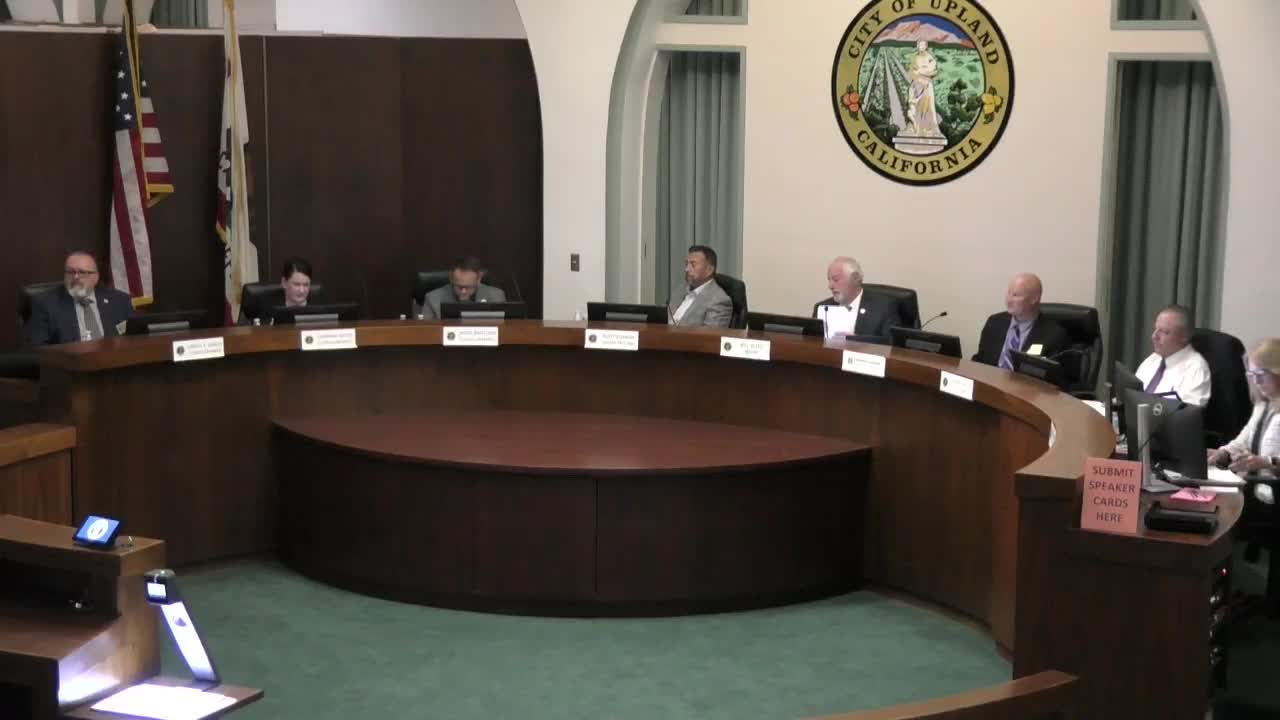
The Upland City Council on Monday voted unanimously to approve a memorandum of understanding (MOU) joining the West End Navigation Center, a regional effort led by San Bernardino County to create a referral-only facility for people experiencing homelessness.
Chief Marcelo Blanco, Upland Police Department, told the council the center will provide 200 beds total — 100 emergency shelter beds and 100 recuperative-care beds — and will include a sobering center. "Initial investment, the county's putting in $20,000,000 for acquisition and improvements, [and] an operating reserve of $5,000,000 to stabilize the startup operation," Blanco said. He told the council the annual operating costs will be shared among the county and participating cities and that Upland's share is about $250,000 per year.
The center will accept clients by referral from participating agencies only, Blanco said, and will co-locate behavioral health, substance-abuse, public-health and workforce services. The MOU aims to distribute costs by a formula that accounts for city population and the communities' point-in-time counts of people experiencing homelessness; Blanco said that formula will be re-evaluated annually.
Why it matters: Supporters said the regional center will offer a humane, centralized alternative to encampments, motels and short-term vouchers while allowing cities to pursue grants as a consortium. Opponents were not recorded during the meeting; councilmembers asked about timing, funding and whether nearby jurisdictions might leave the partnership once they build their own facilities.
Council discussion touched on schedule and funding sources. When asked whether the center could be open by 2026, Chief Blanco said the Fontana partner was pushing for a faster timeline but he considered 2027 more realistic for full operation. Councilmembers also stressed the importance of securing federal and state grant dollars to reduce city costs and to support on-the-ground programs the council called effective.
Council action: Mayor Pro Tem Rudy Zuniga moved to approve the MOU; Councilmember James Breitling seconded. The motion passed unanimously.
Council members and staff said the center could also help the city enforce laws against public drug use by providing guaranteed beds to offer instead of arrest or citation in some cases. Chief Blanco said the navigation center would track clients and that participating cities would share responsibility for individuals who fall out of care.
Background and funding: According to Blanco’s presentation, the county’s initial capital and startup investment ($20 million for acquisition and improvements plus a $5 million operating reserve) will fund property purchase and early operations. Annual operating costs will be shared across participating cities; Upland’s estimated share is roughly $250,000 per year, subject to annual recalculation. Council members noted that Ontario is pursuing its own center and could reduce its participation in the consortium once that facility opens.
What’s next: The MOU takes effect following the council’s approval; construction and operational timelines remain dependent on county and city implementation, grant awards and partner schedules. Chief Blanco said he expects the center to be fully operational in 2027 if planning and construction proceed without major delays.