Get Full Government Meeting Transcripts, Videos, & Alerts Forever!
Get email alerts on the School Property Tax Levies topic
No spam. Unsubscribe anytime.
Committee approves changes to school levy rules, creates fixed‑sum renewal path for some emergency levies
Summary
The panel accepted amendments to House Bill 129 to transition many emergency levies onto the 20‑mill floor over time, create a temporary fixed‑sum renewal for existing emergency levies, and delay calculation changes until districts' next revaluation; opponents sought continuation of rollback credits.
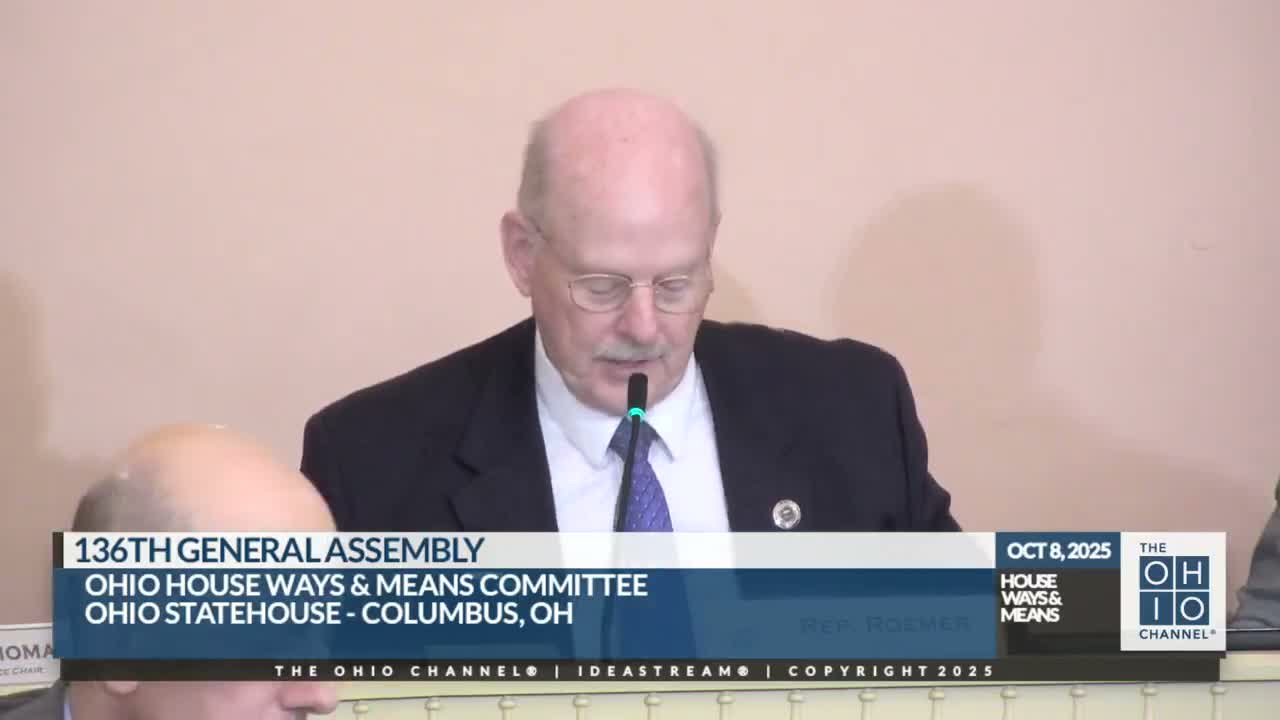
House Ways and Means Committee Vice Chair Thomas explained amendments Thursday to House Bill 129 that aim to limit the ability to reclassify and reallocate certain school property‑tax millage and to clarify how the 20‑mill “floor” applies.
The amendment adopted by the committee allows schools that currently rely on emergency levies to convert one renewal of that levy into a fixed‑sum levy — a request for a specified dollar amount each year — while preserving eligibility for the state’s rollback credits (the 10% nonbusiness credit and the 2.5% owner‑occupied credit) for that single renewal. The amendment also delays moving those revenues into the 20‑mill calculation until the district’s next property revaluation.
Supporters said the changes provide a glide path for districts with long‑standing emergency or substitute levies so taxpayers are not unexpectedly charged higher rates while the state updates how levies are counted against the 20‑mill floor. Vice Chair Thomas said the approach will lift 237 schools off the 20‑mill floor and “prevent future spikes.”
Some members and witnesses pressed for broader grandfathering of rollback credits. Representative Glassburn introduced an amendment to preserve those rollbacks indefinitely for affected levies; Representative Thomas moved to lay that amendment on the table and the committee voted 9–4 to table it. Representative Glassburn said the legislation as adopted initially risked a projected $96 million tax increase tied to eliminating certain rollback credits — a point his amendment sought to address.
Matt Nolan, Warren County auditor and president of the County Auditors Association of Ohio, testified in support of the bill and the negotiated amendments, saying auditors want transparency and consistent treatment statewide. Nolan said auditors’ experience is that the board of county commissioners and budget commissions already scrutinize levies and that codifying the practice will reduce divergences among counties.
Committee action: members accepted the sponsor’s amendment creating the fixed‑sum renewal and delaying changes until revaluation; they also laid Representative Glassburn’s rollback‑preservation amendment on the table by a 9–4 vote. The committee then voted to favorably report House Bill 129 and recommend its passage; a roll call recorded unanimous committee passage at the time of reporting.
The bill and the accepted amendments remain subject to technical harmonization by the Legislative Service Commission before floor consideration; members said additional follow‑up may be needed to resolve rollout of the rollback credits and to address concerns from joint vocational school districts that said the changes could reduce long‑term revenue.