Get Full Government Meeting Transcripts, Videos, & Alerts Forever!
Get email alerts on the Property Tax Budget Commissions topic
No spam. Unsubscribe anytime.
House panel advances bill tightening county budget commission review of levies; advocates warn of DD funding risk
Summary
The Ohio House Ways and Means Committee advanced House Bill 309 after amending definitions and extending a temporary safe-harbor for newly approved levies from one to five years. Supporters said the bill clarifies budget-commission authority; opponents representing county boards of developmental disabilities warned unspecified rollbacks could end‑j
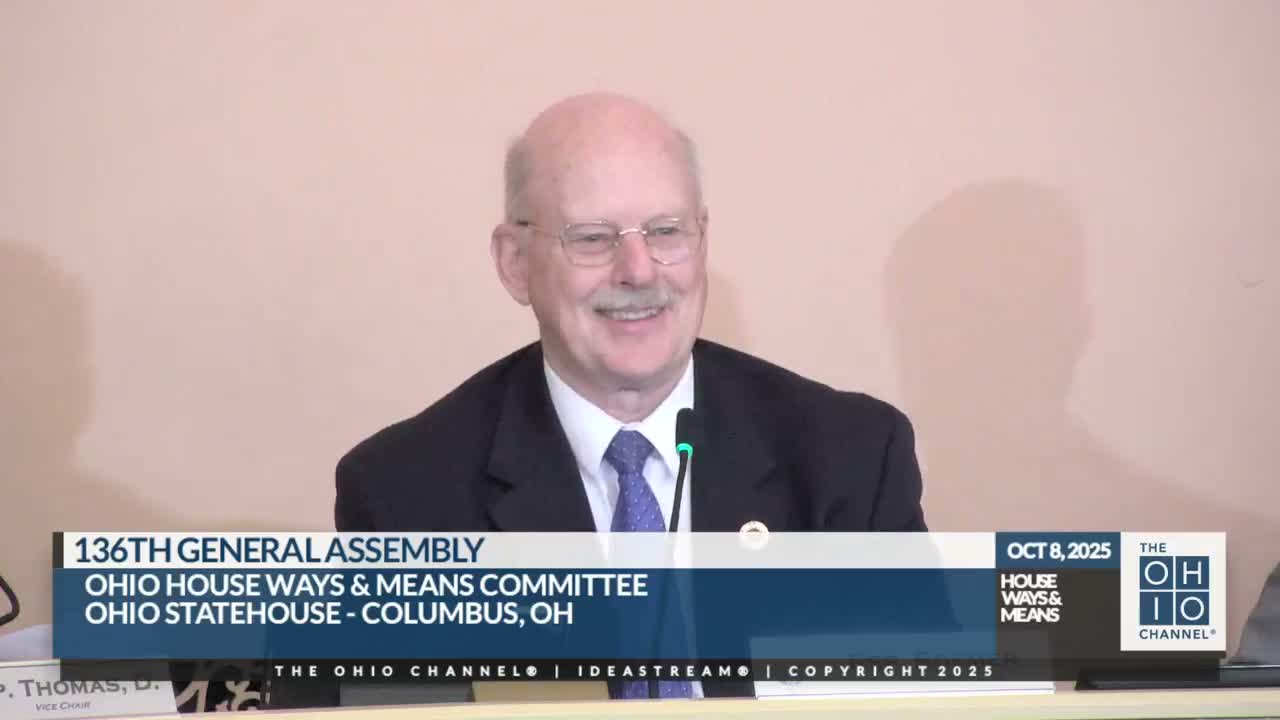
House Ways and Means Committee Chairman Romer said the committee moved House Bill 309 forward Thursday after adopting an amendment that extends a short-term limit on when county budget commissions can reduce newly approved levies.
The bill, as amended, prevents a county budget commission from decreasing a levy within five years of the levy’s first vote and adds definitions for “unnecessary” and “excessive” collections recommended by the governor’s property‑tax study group. The committee accepted the sponsor’s amendment before taking public testimony and ultimately voted to report the bill to the full House.
The change is intended to give local officials and taxpayers clearer standards when a three‑member county budget commission — typically the county auditor, treasurer and prosecutor — reviews local tax levies and collections. “We are the taxpayers’ voice in this whole conversation,” Representative Thomas said while describing the sponsor’s amendment as shifting the safe‑harbor from one year to five years to strengthen taxpayer protections.
Testifying in opposition, Adam Hermann, CEO of the Ohio Association of County Boards of Developmental Disabilities, told the committee county boards rely heavily on local property tax levies to fund services for more than 118,000 Ohioans with intellectual and developmental disabilities. Hermann said the amended substitute is “a step in the right direction” because it adds objective definitions, but he urged additional safeguards so commission decisions “include meaningful input from affected people with developmental disabilities, their families, and the organizations that serve them.”
Hermann said county boards provide roughly half of Ohio’s Medicaid match for developmental‑disability waiver services and gave the committee fiscal figures the boards use for planning: approximately $567,000,000 in state fiscal year 2025, a projected $628,000,000 in fiscal year 2026 and $691,000,000 in fiscal year 2027. He warned that “arbitrary or undefined reductions in local tax collections could destabilize the Medicaid system” that funds direct care, early‑intervention and employment supports.
Matt Nolan, Warren County auditor and president of the County Auditors Association of Ohio, testified in support and said his county has exercised similar levy reductions for two decades to avoid overcollection. Nolan described the change as codifying what some counties already do and said the bill would provide a statutory basis to balance carryover reserves against taxpayers’ interests. “Giving three elected officials the authority to do that — two of whom spend all day every day dealing with property taxes — makes the most sense,” Nolan said.
Committee members questioned how the budget commission will account for statutorily mandated obligations. Hermann noted county boards must submit five‑year cost projections under the Ohio Revised Code and suggested the commission should not cut collections in ways that would undermine those projections. Representative Troy and other members said the appeals process (to the Board of Tax Appeals) remains available if a commission’s decision harms an entity’s ability to operate.
Formal action in committee included adopting the sponsor’s amendment that moved the safe‑harbor to five years. Representative Troy moved a competing amendment that would have provided a one‑year safe‑harbor for renewal levies; the committee voted 8–4 to lay that amendment on the table. Later, the committee voted 13–0 to favorably report the amended substitute House Bill 309 to the full House.
The bill as amended remains subject to further committee and floor review; supporters said it clarifies commission authority, while county‑level DD boards asked legislators to add clearer standards to protect Medicaid‑funded services.