Get Full Government Meeting Transcripts, Videos, & Alerts Forever!
Get email alerts on the Property Taxes topic
No spam. Unsubscribe anytime.
House Ways and Means advances bill giving county budget commissions broader authority over levies; 1-year renewal safe-harbor tabled
Summary
The House Ways and Means Committee advanced a substitute to House Bill 309 that expands definitions for "unnecessary" and "excessive" collections, and extends a restriction that prevents county budget commissions from reducing a voter-approved levy from one year to five years. A separate amendment to add a one-year safe harbor for renewal levieswas
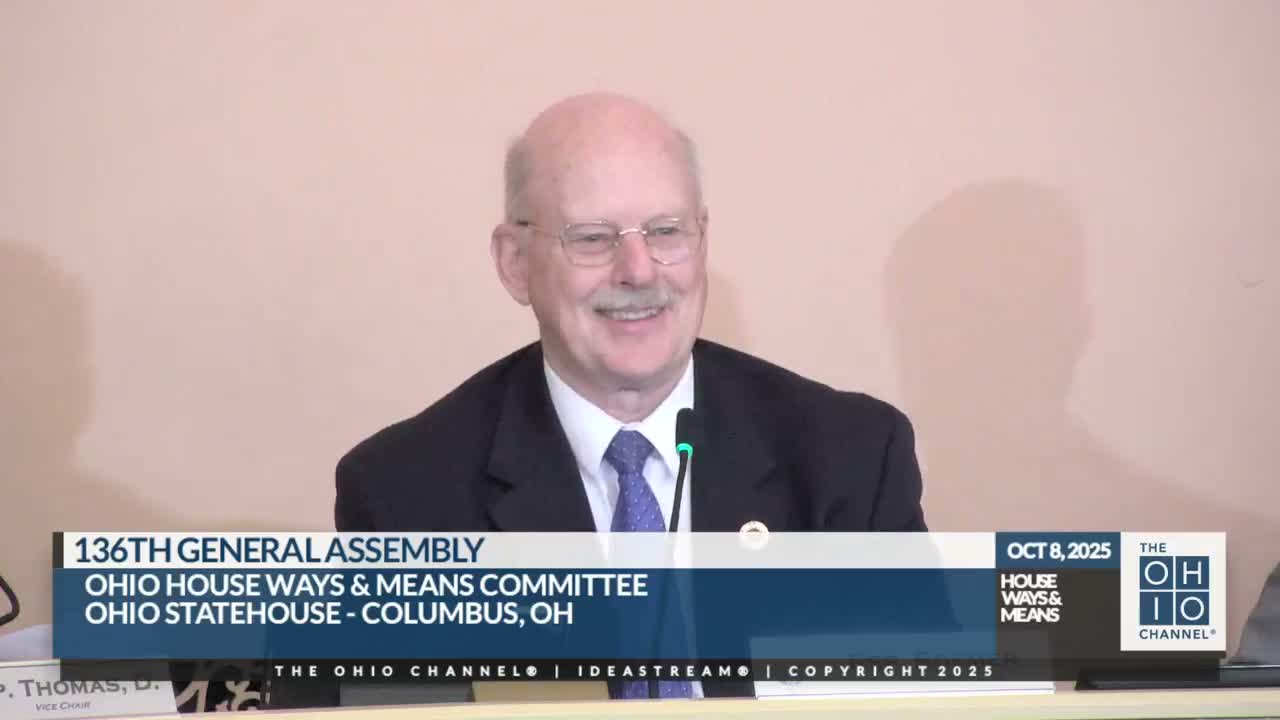
The Ohio House Ways and Means Committee advanced a substitute to House Bill 309, which revises how county budget commissions may review and roll back local property tax levies, after debate Tuesday that included testimony from county auditors and the Ohio Association of County Boards of Developmental Disabilities.
The bill as amended by the committee moves one existing restriction — that a budget commission cannot decrease a levy within one year of the vote that approved it — to a five-year period for all levies and adds definitions for “unnecessary collections” and “excessive collections,” language sponsors said was drawn from the governor’s property-tax study commission.
The changes matter to local governments and service providers because county board levies fund local services and — in the case of county boards of developmental disabilities (DD) — provide a large share of the local match for Medicaid waiver funding that supports home and community-based services.
“While we have stated our strong opposition to House Bill 309, to the as-introduced version, the bill effectively, at that time, gave a 3 person body the power to override the will of thousands or tens of thousands of voters without clear standards,” Adam Hermann, CEO of the Ohio Association of County Boards of Developmental Disabilities, told the committee. Hermann urged the panel to adopt objective standards and to account for county boards’ statutory obligations, including Medicaid match requirements. He said county board levies “do not include inside millage and receive no automatic increases when property values rise” and warned that “arbitrary or undefined reductions in local tax collections could destabilize the Medicaid system.”
Hermann provided figures showing the scale of county boards’ fiscal role: “It must be stated that our county boards provide approximately half of Ohio's Medicaid match for developmental disability services on the waiver program. That totaled about $567,000,000 in state fiscal year 2025, projected to rise to $628,000,000 in the current state fiscal year 2026, and $691,000,000 in state fiscal year 2027.”
Warren County Auditor Matt Nolan, representing the County Auditors Association of Ohio and testifying in support, said local auditors in some counties have for years adjusted levies to avoid collecting more revenue than needed. “As Warren County auditor, my main title, we've been operating as this bill implies for the last two decades,” Nolan said, adding that the three elected officials who make up a county budget commission are accountable to voters and therefore “have to make the right decisions.” Nolan told the committee auditors have used budget reviews to weigh debt service, Medicaid obligations and other needs before reducing levies.
Committee debate included a proposal to create a shorter, one-year safe harbor for renewal levies so that newly renewed levies would not immediately be subject to rollback by a budget commission. Representative Troy, who offered that amendment, said a one-year safe harbor would at least allow newly renewed levies a brief period before review. Representative Thomas, sponsor of the bill amendment moving the safe-harbor language to five years, countered that when collections are “excessive” they are excessive regardless of whether they occur in year one or year six and described the five-year period as a compromise.
Representative Thomas moved to lay Representative Troy’s one-year amendment on the table; that motion carried on a roll-call vote of 8 affirmative and 4 negative (see actions below). After concluding testimony and discussion, the committee voted to favorably report the substitute to House Bill 309 and recommend its passage. The committee’s roll call recorded a unanimous 13-0 vote in favor of reporting the bill to the full House.
Committee members and witnesses repeatedly emphasized the availability of appeals and further review: staff noted that actions by a county budget commission may be appealed to the Board of Tax Appeals.
The committee asked Legislative Service Commission staff to harmonize and engross the accepted amendments and the substitute bill before it leaves committee.
Votes at a glance: the committee accepted the sponsor’s substitute amendment incorporating the five-year restriction and new definitions by voice without objection; it laid a different amendment (the one-year renewal safe harbor) on the table, 8–4; and it unanimously voted 13–0 to favorably report the substitute to House Bill 309 to the full House.
Looking ahead, sponsors said they expect additional work on standards and implementation language in later stages and that the Senate could further refine how commissions account for multi-year obligations such as Medicaid match and debt service.