Get Full Government Meeting Transcripts, Videos, & Alerts Forever!
Get email alerts on the Traffic Speeding topic
No spam. Unsubscribe anytime.
Middleburg council discusses traffic safety after resident complaint; police say speed data don't meet state threshold for extra fines
Summary
A resident urged the Middleburg Town Council to address speeding on the town's east side. Police presented a speed study showing 85th-percentile speeds below the 10-mph threshold required to qualify for a state-authorized $200 enhanced fine; council members discussed alternative measures including enforcement and pedestrian-safety hardware.
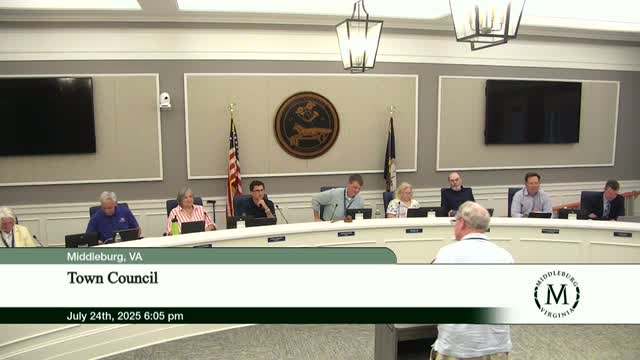
A Middleburg resident urged the Town Council on July 24 to find a “permanent fix” for speeding on the east end of town as council and police detailed current speed data and possible safety measures.
John Pittman, of 12 Piedmont Drive, told the council during public comment that the 20 mph signs installed in town have not slowed drivers on the east end and asked the council, the town manager and the police chief to “put their heads together and figure out some alternative, feasible alternatives that could help slow the traffic flow.”
Town Police Chief Sean Jones responded later in the meeting with a summary of a speed study the department conducted. Jones said the study measured the 85th-percentile speeds at the points where the posted limit drops from 25 mph to 20 mph and found eastbound speeds of 26.97 mph and westbound speeds of 28.04 mph. “Regardless of the speed limit… the values do not exceed the 10 miles per hour or above,” Jones said, describing that statutory threshold as the requirement to qualify for signage that would allow an additional $200 fine.
Because the measured speeds fell short of that 10-mph threshold, Jones said the town does not qualify for the state program that permits special $200-enhanced speeding fines. He listed alternatives the town could pursue, including rectangular rapid-flashing beacons (RRFBs) at crosswalks, higher-visibility pedestrian signs, portable advanced-warning signs and continued enforcement using officers and, where available, lidar equipment to single out speeders.
Council members and staff raised practical and equity questions about next steps. Council member Pam Curran said her primary concern was safety and asked how the town would ensure buses for the Hill School and visitors could navigate if the town imposed closures or more physical traffic controls. Mayor Peter Leonard Morgan and other council members urged the police and town staff to gather more detailed, town-center data before deciding on larger investments.
Several council members suggested moving the town’s portable speed signs to different downtown locations for short measurement periods to capture speeds closer to the core pedestrian area, rather than only at the posted-limit transitions. Chief Jones said the portable signs can be relocated and that staff would explore options for a more “holistic” speed study or targeted enforcement.
Council members also asked for enforcement statistics and said they wanted to know how many speeding citations had been written recently in the zones of concern; the police said they would provide ticketing data to council. Jones said officers have been issuing warnings when they observe speeding but that he would supply formal citation counts on request.
The council did not take any formal votes on traffic measures at the July 24 meeting. Town staff said they will continue to monitor speeds and pedestrian-safety conditions and return to council with options that could include relocated portable signs, targeted enforcement, pedestrian safety hardware and coordination on placement with the town manager and public-works staff.