
Deschutes County public hearing draws heated debate over proposed Map C for commissioner districts
Get AI-powered insights, summaries, and transcripts
Subscribe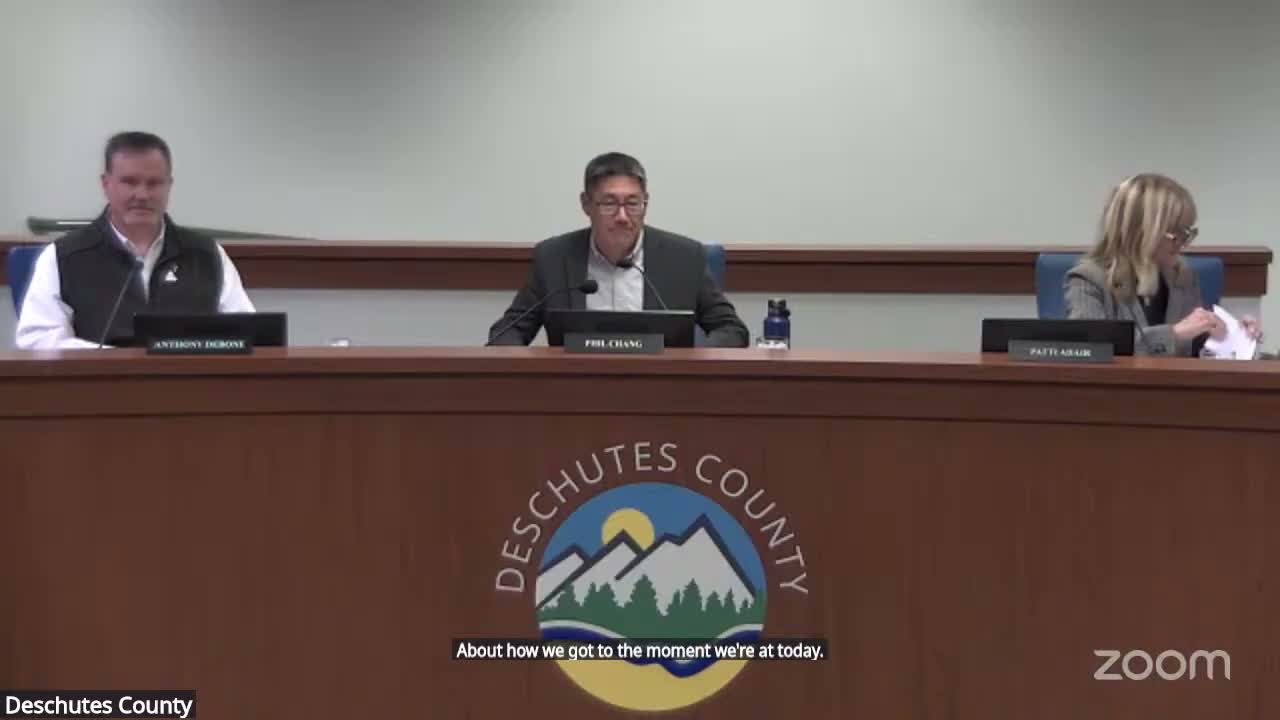
Summary
At a packed hearing, dozens of residents urged and opposed the DMACC-recommended 'Map C' for five commissioner districts. Supporters said districts protect rural representation; opponents called the map gerrymandered, raised legal challenges and flagged potential litigation costs. Commissioners will deliberate tomorrow.
Deschutes County commissioners heard more than two hours of public comment Wednesday on a proposed five-district map, known as Map C, that would change how the county elects its expanded Board of County Commissioners.
County staff told the audience the process began after voters approved Measure 9-173 in November 2024 to increase the commission from three to five members. Jen Patterson, Deschutes County strategic initiatives manager, told the board the DMACC (District Mapping Advisory Committee) was formed by the commission in May and met roughly 10 times to consider maps and public input. “On 03/31/2025, the Board of County Commissioners voted to initiate the process of drafting commissioner district maps for voters to consider in 2026,” Patterson said.
Map C, the DMACC’s majority recommendation, was described by Patterson as the committee’s preferred option. She said the committee also recommended a random process to number districts and that, if voters approve a map, the county should require redistricting after the 2030 census.
Public comment split sharply.
Opponents repeatedly called Map C a partisan gerrymander and urged the board to postpone action until after the next census. “This rigged map divides us into one political party or the other,” Michelle Martin said, accusing the map of “ripping us apart.” Several speakers, including DMACC member Carol Leshy and representatives of the League of Women Voters, urged the board not to conduct mid-cycle redistricting and to wait for the 2030 census so drawing can be based on complete population data.
Legal concerns were a recurring theme. An attendee with a legal background told the board election districts must use total population, not registered voters, and cited state guidance to that effect. “Counting registered voters rather than all residents, including both children and unregistered adults, gives more weight to some residents’ votes and less to others,” the speaker said, warning the map could be overturned in court.
Pete Shepper, who described litigation risk in fiscal terms, estimated the county could face “approximately a $103,000” in litigation expense even if it prevailed and substantially more if it lost. “Proceeding with the measure” without further analysis of that risk, he said, “is tantamount to playing craps with taxpayers’ money.”
Supporters of Map C said districts would protect rural communities and increase geographic representation. Dave Clem of Crooked River Ranch said the map “fairly represents the population and voters of Deschutes County” and warned that at-large elections could allow one densely populated city to determine all five seats. DMACC member Andrew Casa told the audience he did not believe the process was rushed and defended some committee constraints while acknowledging the final map may face legal challenges: “I do think this map is legally flawed, and I think some of us on the committee said that,” Casa said.
Several speakers offered alternatives, including proportional ranked-choice voting and a Missouri-style hybrid (district representatives elected but all voters voting for all seats). Others urged a binary ballot question — a simple yes/no on districting rather than presenting a particular map — to let voters decide the system before maps are settled.
The board did not take a vote Wednesday. Chair Chang (identified in the hearing) closed the evening session saying deliberations would resume at 9:00 a.m. Thursday to consider whether to refer a map to voters and whether to put it on the May or November 2026 ballot. Staff directed listeners to dischutes.org/dmac for draft maps, meeting recordings and submitted public comments.
The county’s next procedural step is a scheduled deliberation at the board’s regular meeting tomorrow morning; any decision to refer a map to voters would be followed by a ballot title drafting and potential legal review.