
Germantown review of parent survey finds broad satisfaction but mixed support for aligned elementary start times; committee to return in February
Summary
A district committee reviewed two parent surveys on elementary school start/end times and heard that while about three-quarters of respondents say they are satisfied with current schedules, many also favor a single, aligned schedule. Officials warned any change could increase bus ride times and require reallocating roughly $75,000 in district funds.
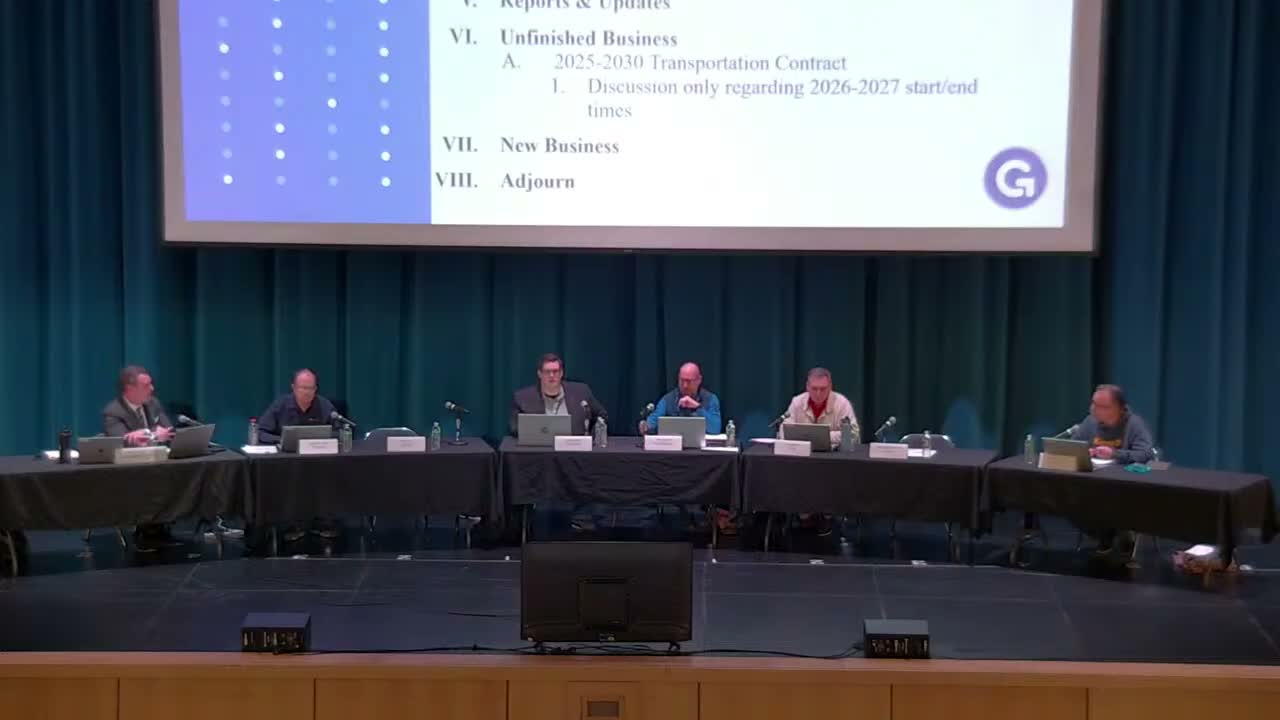
The Germantown School Districtadad hoc transportation committee on Tuesday reviewed two parent surveys and discussed whether to align elementary school start and end times for the 2026-27 school year.
Superintendent Chris Reuter told the committee a preliminary December survey of K–4 families produced a little more than a 20% response rate and that responses were mixed: “We had over a 20% response rate,” Reuter said, and the results included both strong satisfaction with current staggered times and openness to alignment. A second, school-specific survey followed to clarify how families at each building feel.
Why it matters: aligning times across elementary schools can simplify family schedules and childcare arrangements, but it can also lengthen some studentsbus rides and add operational costs. Reuter said a near-term reallocation of about $75,000 could be required to reconfigure routes this year; that figure could change depending on route details and parochial-school coordination.
Board members on the committee pressed staff for details on how the districtwould avoid creating excessively long runs for students at the ends of routes. Members emphasized that the districthas a tiered routing system tied to middle- and high-school runs; losing that tiering could drive costs significantly higher. Committee discussion referenced both a $75,000 reallocation estimate and higher estimates ($120,000 or more) depending on which private-school routes are combined or whether tiering is retained.
School-level differences loomed large. Committee members said MacArthur families are particularly divided on the trade-off between cost and additional bus time; County Line families showed higher sensitivity to operational changes; Amy Bell and Rockfield remain heavily bus-reliant and showed more resistance to longer rides.
Committee action and next steps: no vote was taken; members directed staff to gather more route-level data and vendor input (including from the districtbus contractor) and to return in February with recommendations. The chair asked families who did not respond to the surveys to review the posted packet and send comments before the committee reconvenes.
The committeeplans to meet again in February and said any formal recommendation to the full board would follow that meeting.

Create a free account
Unlock AI insights & topic search